Cold Facts Magazine
A Year of Transition
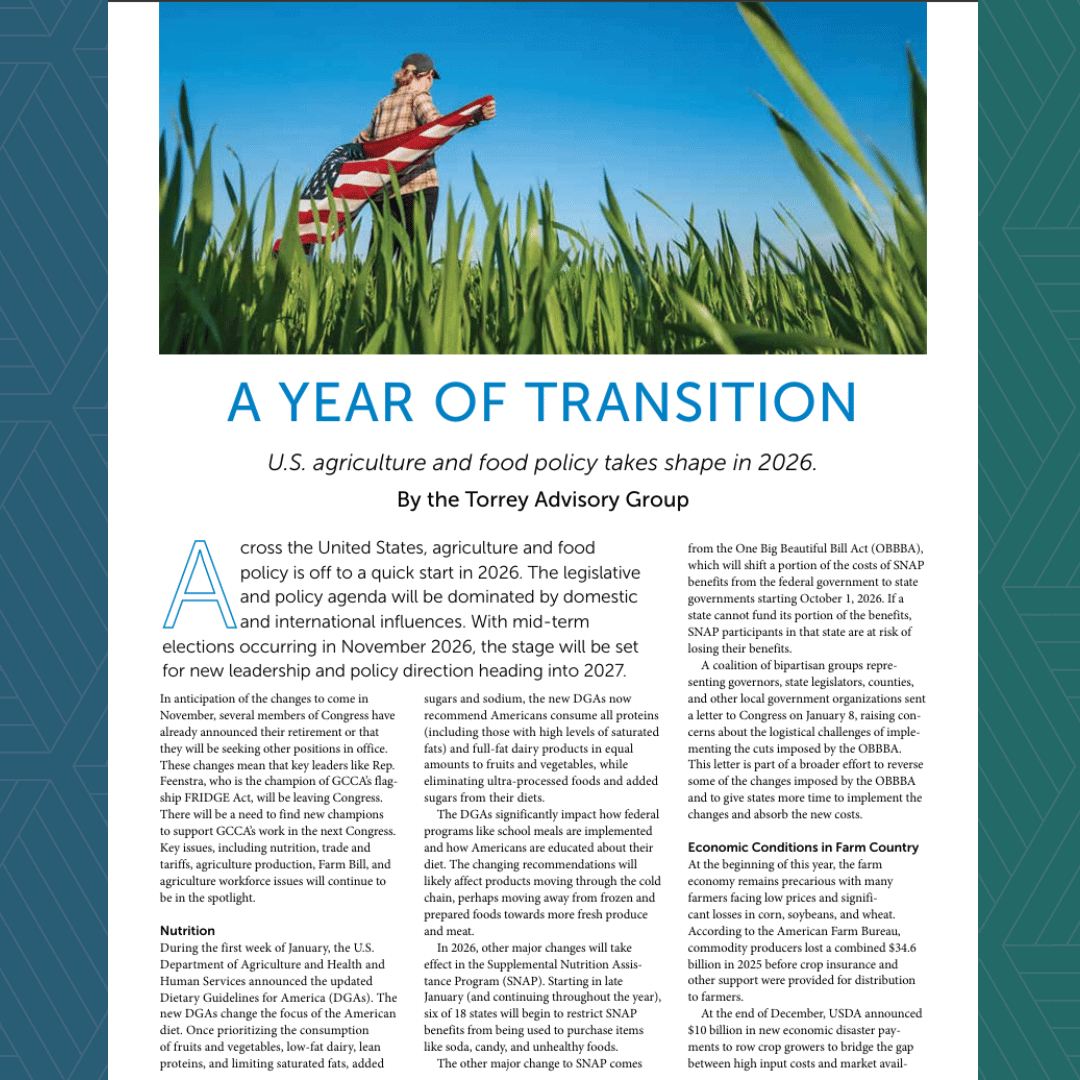
U.S. Agriculture and Food Policy Takes Shape in 2026
Across the United States, agriculture and food policy is off to a quick start in 2026. The legislative and policy agenda will be dominated by domestic and international influences. With mid-term elections occurring in November 2026, the stage will be set for new leadership and policy direction heading into 2027.
In anticipation of the changes to come in November, several members of Congress have already announced their retirement or that they will be seeking other positions in office. These changes mean that key leaders like Rep. Feenstra, who is the champion of GCCA’s flagship FRIDGE Act, will be leaving Congress. There will be a need to find new champions to support GCCA’s work in the next Congress. Key issues, including nutrition, trade and tariffs, agriculture production, Farm Bill, and agriculture workforce issues will continue to be in the spotlight.
Nutrition
During the first week of January, the U.S. Department of Agriculture and Health and Human Services announced the updated Dietary Guidelines for America (DGAs). The new DGAs change the focus of the American diet. Once prioritizing the consumption of fruits and vegetables, low-fat dairy, lean proteins, and limiting saturated fats, added sugars and sodium, the new DGAs now recommend Americans consume all proteins (including those with high levels of saturated fats) and full-fat dairy products in equal amounts to fruits and vegetables, while eliminating ultra-processed foods and added sugars from their diets.
The DGAs significantly impact how federal programs like school meals are implemented and how Americans are educated about their diet. The changing recommendations will likely affect products moving through the cold chain, perhaps moving away from frozen and prepared foods towards more fresh produce and meat.
In 2026, other major changes will take effect in the Supplemental Nutrition Assistance Program (SNAP). Starting in late January (and continuing throughout the year), six of 18 states will begin to restrict SNAP benefits from being used to purchase items like soda, candy, and unhealthy foods.
The other major change to SNAP comes from the One Big Beautiful Bill Act (OBBBA), which will shift a portion of the costs of SNAP benefits from the federal government to state governments starting October 1, 2026. If a state cannot fund its portion of the benefits, SNAP participants in that state are at risk of losing their benefits.
A coalition of bipartisan groups representing governors, state legislators, counties, and other local government organizations sent a letter to Congress on January 8, raising concerns about the logistical challenges of implementing the cuts imposed by the OBBBA. This letter is part of a broader effort to reverse some of the changes imposed by the OBBBA and to give states more time to implement the changes and absorb the new costs.
Economic Conditions in Farm Country
At the beginning of this year, the farm economy remains precarious with many farmers facing low prices and significant losses in corn, soybeans, and wheat. According to the American Farm Bureau, commodity producers lost a combined $34.6 billion in 2025 before crop insurance and other support were provided for distribution to farmers.
At the end of December, USDA announced $10 billion in new economic disaster payments to row crop growers to bridge the gap between high input costs and market availability that has been disrupted by trade and tariffs. An additional $1 billion will be made available to sugar and specialty crop farmers.
On the flip side, beef prices have been at an all-time high compared to the past 75 years, according to the Kansas City Federal Reserve, due to low herd sizes and high demand. Many leading agricultural economists fear that without additional economic support or new international markets, farmers are in for another year of uncertainty and may incur additional loss.
Farm Bill
The uncertainty of the nutrition programs coupled with unstable conditions in farm country will be driving forces of a potential new Farm Bill. House and Senate Agriculture Committee Republicans are saying publicly that they would like to see a Farm Bill pass into law in 2026 to finish what was started in the One Big Beautiful Bill Act (OBBBA). They have characterized the remaining provisions in the Farm Bill as about 20% funding and 80% policy and have said there is some flexibility to fund issues left out of OBBBA and further address the economic conditions imposed by tariffs.
Democrats on Capitol Hill are not enthusiastic about a Farm Bill that limits conversations about nutrition programs and farm programs addressed in OBBBA, seeing both issues as critical to getting their support to pass the bipartisan threshold required in the Senate.
The path forward is still very uncertain, with little indication that the Senate has a plan for a comprehensive farm bill. It is still unclear whether the House will try to move a partisan or bipartisan bill through committee, and if House leadership has agreed to a floor vote. As with years past, the Farm Bill will expire at the end of September, and further Congressional action will be required in 2026 to suspend permanent law and avoid skyrocketing commodity prices.
Trade and Tariffs
The Supreme Court of the United States is expected to release its decision in early 2026 on whether President Trump’s International HygenAir™ A+H Hygienic Air Handler Emergency Economic Powers Act (IEEPA) tariffs, applied against nearly every country in early 2026, have legal standing. The decision, regardless of outcome, will greatly affect trade policy going forward from both the U.S. government and its trading partners. This includes the first review of the U.S.-MexicoCanada Agreement that is due in July. Details of how the three parties will engage in the review are limited, but it’s anticipated that the United States will seek to make changes to certain parts of the agreement around tightening rules of origin for products beyond autos.
It’s also expected that the first review will not result in a unanimous agreement between the countries to automatically renew the agreement for another 16 years.
Based in Washington D.C., the Torrey Advisory Group provides strategic advice and representation on behalf of the Global Cold Chain Alliance. To find out more about GCCA advocacy work contact sbrennan@gcca.org.
Contact Us
COLD FACTS Magazine and media inquiries: Lindsay Shelton-Gross, Senior Vice President, Global Communications, Marketing and Strategic Initiatives, Global Cold Chain Alliance
Editorial Ideas: Please contact Editor-In-Chief Alexandra Walsh
Advertising Opportunities: Contact Jeff Rhodes, Vice President of Sales, MCI USA Sales