Cold Facts Magazine
Driving the Cold Chain
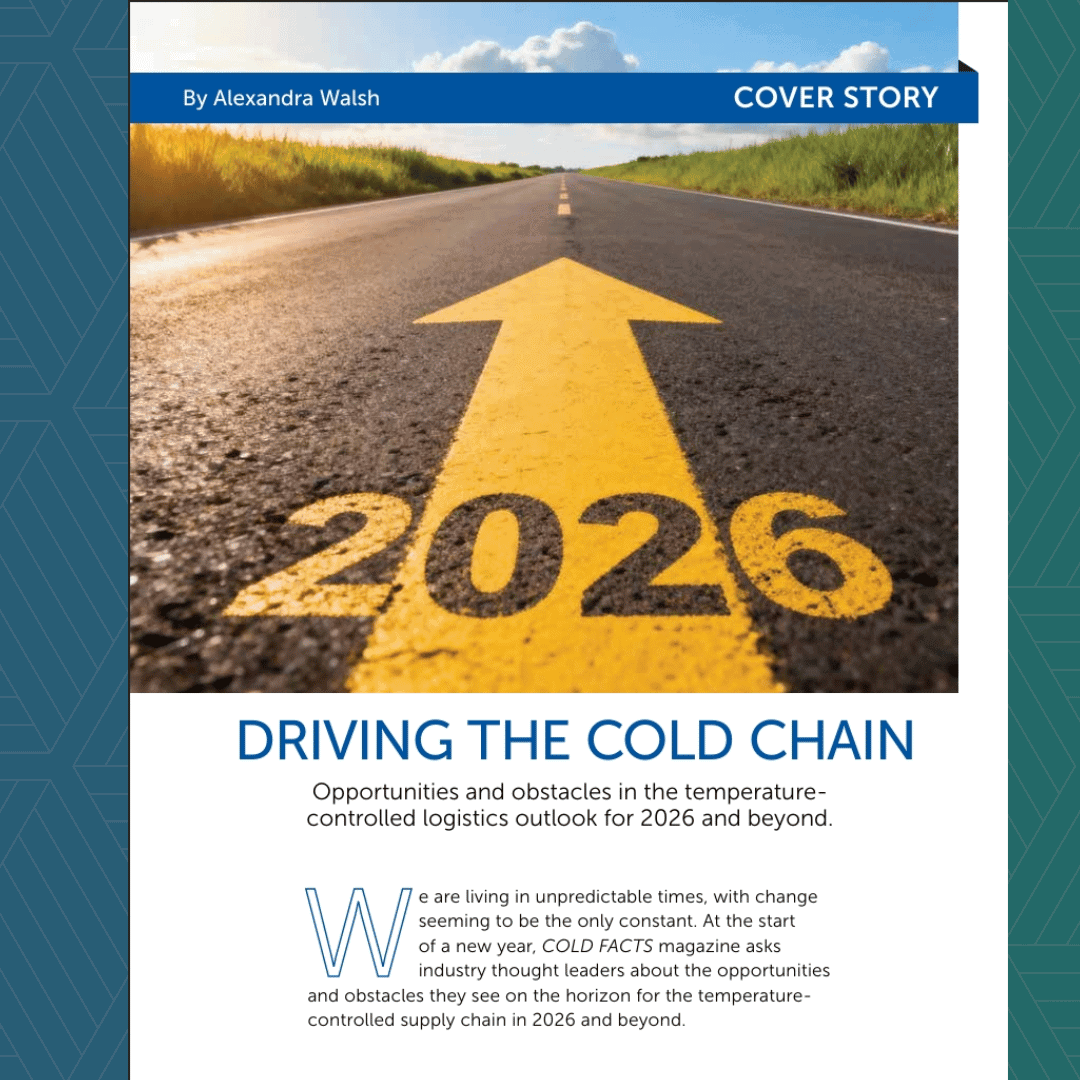
Opportunities and Obstacles in the Temperature-Controlled Logistics Outlook for 2026 and Beyond
We are living in unpredictable times, with change seeming to be the only constant. At the start of a new year, COLD FACTS magazine asks industry thought leaders about the opportunities and obstacles they see on the horizon for the temperature-controlled supply chain in 2026 and beyond.
Change and Opportunity
“In essence, 2026 is a pivotal year for cold storage: an opportunity to lead through technology, sustainability, climate preparedness, and by enabling the evolving needs of food supply chains,” begins Francisco Moura, CEO of SuperFrio Logistica Frigorificada.
Automation and digitalization in warehouses will accelerate this year, adds Moura. “Robotics, AI-driven inventory management, and predictive maintenance are essential for improving throughput and reducing labor dependency. Leading players are already deploying advanced systems to optimize space utilization and energy efficiency.”
Moura notes that climate volatility is accelerating, placing unprecedented pressure on critical infrastructure and disrupting power grids and transportation networks. “Cold storage facilities must invest in contingency planning, backup energy systems, and structural resilience to safeguard temperature integrity during crises.”
Reducing energy and food waste remains a critical focus across the cold chain, points out Adam Forste, Co-Chair of Lineage. “Energy efficiency is no longer just about cost management; it’s about resilience. Smarter refrigeration controls, AI-enabled energy management, and tools that dynamically respond to demand, weather, and utility conditions can significantly reduce energy use while also maintaining strict temperature integrity and strengthening uptime during peak loads, grid stress, and disruption events,” notes Forste.
Food waste reduction is equally tied to better data to help ensure that product is stored and moved where it’s needed most, reducing dwell time and spoilage risk, explains Forste. “When disruptions do occur, having systems and partnerships in place to responsibly redirect product to secondary markets or communities in need, rather than send it to a landfill, remains an important part of the solution.”
GLP-1 medications will continue reshaping demand patterns. Moura explains the therapies are reducing overall food consumption while increasing demand for high protein and nutrient-dense products – many of which require refrigerated storage. “At the same time, GLP 1 biologics themselves require strict cold chain handling, creating new demand for pharmaceutical-grade warehousing,” says Moura.
Global Perspectives
Latin America remains one of the most promising regions for the global temperature-controlled supply chain, accounting for 25% of global food exports and playing a vital role in ensuring global food security, notes Rafael Rocha, Senior Vice President, Emergent Cold LatAm.“In 2026, we see strong opportunities in the expansion of logistics hubs near ports and major consumption centers. These hubs increase efficiency, reduce food loss, and bring resilience to the supply chain, and the company is building modern facilities in these key areas across our network.”
Network optimization and capacity expansion remain critical, Moura points out. “The year has already begun with heightened trade tensions, Operators must anticipate shifts in import/export flows and position capacity closer to consumption hubs to mitigate volatility and capture growth in emerging markets.”
Nicholas P. Pedneault, CEO of Congebec, expects an increased focus on supply chain resiliency this year. “I anticipate a pivot on Canada’s trade markets, and we support our clients as they expand their global footprint.”
“Stubbornly high food inflation has been a persistent issue since the pandemic, prompting consumers to shift toward more affordable proteins, and as a result, we can expect increased demand for chicken and pork when BBQ season returns in the spring,” says Greg Laurin, President of Conestoga Cold Storage. “If domestic producers are unable to meet this demand in the short term, import volumes of proteins from South America – and even beef and lamb from as far away as Australia – will likely continue to grow.”
Laurin says retailers, hesitant to pass additional costs on to already strained consumers, are putting mounting pressure on manufacturers to hold the line on price increases. “Further down the supply chain, this dynamic has made it increasingly difficult for cold storage providers to recover the significant cost escalations we have faced in labor, insurance, and building expenses over the last several years.”
Cold storage and food manufacturing facilities are major investments, and with uncertainty surrounding the upcoming USMCA (United States-Mexico-Canada Agreement) renewal in July, Laurin says he is already seeing projects on both sides of the border delayed or cancelled by companies reluctant to commit to significant capital expenditures when questions remain about the future direction of trade policy and the potential implementation of new tariffs within North America.
“If leaders are able to successfully renegotiate the USMCA agreement, we could face a shortage of both manufacturing and warehouse capacity in the years ahead, driven by the cumulative effects of today’s project pauses and construction slowdowns,” notes Laurin.
While population levels are stabilizing or even declining in North America, pet ownership continues to grow significantly. Laurin explains that consumers are seeking higher protein, less processed foods not only for themselves but also for their pets. He points out that this shift presents a meaningful opportunity for cold storage operators to capture additional volume in the frozen pet food segment that is expected to expand into a $10 billion market within the next decade.
Value-Added Now Expected
Customers are increasingly looking to 3PL partners to help reduce friction, simplify complexities, and provide better visibility across their supply chains, according to Forste.
“One clear trend is multi-vendor consolidation, where shipments from multiple suppliers are combined into scheduled, shared truckloads to help reduce costs, improve delivery reliability, and meet strict delivery windows – effectively turning a historically variable logistics process into a more predictable, repeatable, and efficient operation,” Forste says.
Another growing expectation is data-driven insights. “More customers are asking logistics providers not just to move product, but to help analyze their end-to-end networks, looking at inventory, transportation, and networks to identify smarter, more streamlined ways to operate,” notes Forste. “Our data science and network analysis capabilities are one example of how advanced modeling and analytics are being used to support better decision-making across the cold chain, from forecasting and replenishment strategies to route optimization and facility selection.”
Forste points out that as supply chains grow more interconnected, customers value partners with facilities positioned near major ports, population centers, and production hubs. “We have also seen an increased need for import and export capabilities, like customs-bonded warehousing and services that help product move more smoothly across borders,” says Forste. “When done right, this kind of integrated footprint supports greater reliability, flexibility, and continuity, and ultimately helps drive value for customers.”
Risk mitigation to counterbalance possible uncertainty is now a value-added service, Pedneault says. “To mitigate risk, we strive for robustness in our service offerings. Rail is an interesting solution we are exploring as it offers more stability, efficiency, and better cycle time to our customers.”
In addition, Pedneault says as the population continues to be impacted by the increasing cost of food, customers are asking him to do more with less to help fight inflation.
Rocha notes that in Latin America, the definition of value-added services is also evolving rapidly and centers on being a true partner in the customer’s logistics strategy.
“We’ve seen a clear shift in expectations: customers are asking for fully integrated solutions that combine storage, transportation, handling, documentation, and traceability in a single, seamless experience,” Rocha says. He adds that it is especially important in a region with complex regulatory environments, export procedures, and infrastructure gaps.
Clients are also seeking greater visibility and control, which Rocha accommodates by investing in systems integration and real-time data. In some cases, what used to be value-added — like blast freezing, cross-docking, or bonded warehousing — Rocha says is now simply expected.
He says at the same time, new demands are emerging: support for export flows, customs clearance, multi-temperature handling, and even collaborative planning to respond to shifts in demand. In response, Rocha notes the company has expanded its transportation network and integrated digital platforms to support cross-border operations.
“3PLs are no longer just operators,” explains Rocha. “We’re enablers of agility, efficiency, and regional growth. And that’s exactly where we believe our long-term investments in people, technology, and infrastructure make the difference.”
Sustainability and resilience are equally critical, notes Moura. “Customers expect providers to deliver green energy sourcing, carbon footprint tracking, and contingency planning for climate-related disruptions. Investments in backup power systems, flexible temperature zones, and pharma-grade storage for biologics such as GLP-1 medications are emerging as differentiators.”
In short, Moura says third-party logistics is evolving from a transactional role to a strategic partnership offering integrated, technology-driven, and sustainability-focused solutions that anticipate market volatility and changing consumer trends.
“This transformation is redefining what ‘value-add’ truly means in the cold chain,” says Moura.
Shifting Last-Mile Delivery
“In Latin America, we’re seeing important operational shifts in last-mile delivery – but not necessarily driven by online grocery or e-commerce,” says Rocha. “The region’s food logistics landscape is still largely driven by wholesale, foodservice, retail distribution, and exports, which require a different type of last mile solution: one that is reliable, temperature-controlled, and aligned with regulatory and urban infrastructure challenges.”
Rocha explains that what’s emerging is the need for more agile and localized distribution models – especially in dense urban areas and around major ports. He notes that this includes investments in multi-temperature transport, port transfer (T1 and T2) operations, and cross-dock platforms that bring products closer to the point of consumption or export.
“We are responding to this shift by embedding last-mile logistics into our network design, and through strategic partnerships with 3PL transporters, complemented by technology for routing, visibility, and service level performance,” Rocha says. “Rather than micro-fulfillment, the focus in Latin America is on scalable, compliant, and efficient last mile delivery for B2B operations – especially in high-growth markets where infrastructure is still catching up with demand. This is where we see the opportunity to create long-term value through operational excellence and regional integration.”
Over the past year, Moura has seen exponential growth in demand for rapid, reliable, and traceable delivery of perishable goods driven by consumer expectations for convenience and freshness. “Micro-fulfillment centers, dark stores, and urban cold hubs are becoming essential to reduce delivery times and maintain temperature integrity. Investments in advanced route optimization, IoT-enabled monitoring, and electric or hybrid refrigerated fleets are critical to meet sustainability goals while ensuring service reliability.”
Additionally, the rise of subscription-based meal kits, fresh protein delivery, and pharmaceutical e-commerce demand specialized handling and strict compliance with temperature standards. “These factors are pushing providers to offer end-to-end solutions that combine warehousing, packaging, and last-mile execution under a single integrated platform,” Moura says.
Moura believes last-mile delivery is no longer a peripheral service – it is a strategic growth engine.
Transformative Tech
The most exciting technologies are those that combine automation, data intelligence, and sustainability, Moura contends. “In 2026, we are prioritizing investments in IoT-enabled monitoring for real-time temperature control, advanced picking intelligence to optimize order preparation, and productivity-enhancing tools for warehouse operations,” says Moura. “AI is a real enabler, but our approach is pragmatic: implement solutions that deliver measurable value to customers and align with our operational realities in Latin America.”
Pedneault notes the company’s IT platform is a key asset. “We have a dedicated in-house development team that builds our own WMS and digital tools, which we share with independent partners for seamless collaboration and a unified global solution,” he says. “If a customer needs inventory in the northeastern United States, where we lack facilities, we can partner with a local warehouse using our systems to ensure a consistent customer experience and maintain the same EDI relationship. Rather than traditional M&A, Pedneault views collaboration as a more efficient way to build large-scale capabilities with minimal disruption.
Laurin is very excited about recent progress in the world of automatic guided vehicles (AGVs). He notes that while AGVs have existed in various forms for years, significant advancements in sensors and related technologies – much of it originating from the automotive and robotics sectors – have accelerated their capabilities. “Developers are now integrating AI into machine programming, enabling AGVs to operate with far greater autonomy and to work more seamlessly alongside people in today’s highly active warehouse environments.”
According to Laurin, AI is being adopted at a measured and deliberate pace but he remains cautious about safeguarding customer and corporate data. “Our IT department, however, is implementing AI at a more accelerated rate, integrating powerful new tools across nearly all areas of programming, support, and strategy.”
Lineage is also focused on technologies that help reduce waste before it happens. “Data-driven platforms give customers better visibility into inventory and supply-chain activity, helping them make more informed decisions about production, storage, and movement,” Forste says. “That kind of insight can limit excess handling and dwell time, which ultimately reduces food and energy waste across the network while strengthening service levels and responsiveness.”
Challenges to Overcome
Over the next five years, Laurin believes the industry will be tested by Amazon’s entry into the storage market to control last-mile delivery; the impact of GLP-1 drugs on food consumption; and whether aging facilities can be automated with AI and autonomous vehicles to extend their lifespan.
Topping Moura’s list of industry challenges are climate change and extreme weather events and the shift to e-commerce that demands new last-mile strategies, urban cold hubs, and micro-fulfillment centers to meet consumer expectations. In addition, Moura says industry challenges will define competitiveness such as decarbonizing operations, integrating renewable energy, and deploying AI for predictive analytics and warehouse optimization.
“Over the next few years, the cold chain industry – especially in Latin America – will need to address the challenge of scaling capacity while improving reliability, efficiency, and sustainability,” points out Rocha. “Demand for temperature-controlled logistics is growing fast across the region, driven by food exports, population growth, and shifting consumption patterns. But much of the infrastructure is still fragmented, outdated, or concentrated in only a few urban areas.”
The industry’s challenge, Rocha believes, will be modernizing and expanding infrastructure in ways that keep pace with this growth while also addressing rising energy costs, climate volatility, customer expectations, and developing talent and operational excellence at scale.
“Regaining the trust of our customers that we are the experts in what we do will be our biggest challenge,” admits Pedneault. “Even though the cold chain expanded, it did so at the expense of service quality.”
Pedneault says the ‘Cold Rush’ attracted many opportunists to the industry, and many customers have expressed dissatisfaction with the service they are receiving in the cold logistics marketplace.
Looking Forward and Working Together
The temperature-controlled supply chain is being reshaped – entering a new era marked by rapid technological adoption, rising customer expectations, and intensifying pressures from climate volatility, trade uncertainty, and cost inflation.
Across regions, these leaders agree that long-term success will hinge on moving beyond transactional services toward integrated, data-driven, and sustainability-focused partnerships that add measurable value across the supply chain. While challenges still loom large; the consensus is pretty clear: companies that invest strategically today will be positioned to lead, differentiate, and support the global food systems of tomorrow.
“Some customers are taking advantage of excess capacity to insource their cold chain needs. Operators need to work together to gain their trust back” says Pedneault.
Contact Us
COLD FACTS Magazine and media inquiries: Lindsay Shelton-Gross, Senior Vice President, Global Communications, Marketing and Strategic Initiatives, Global Cold Chain Alliance
Editorial Ideas: Please contact Editor-In-Chief Alexandra Walsh
Advertising Opportunities: Contact Jeff Rhodes, Vice President of Sales, MCI USA Sales