Cold Facts Magazine
Europe’s New Networks
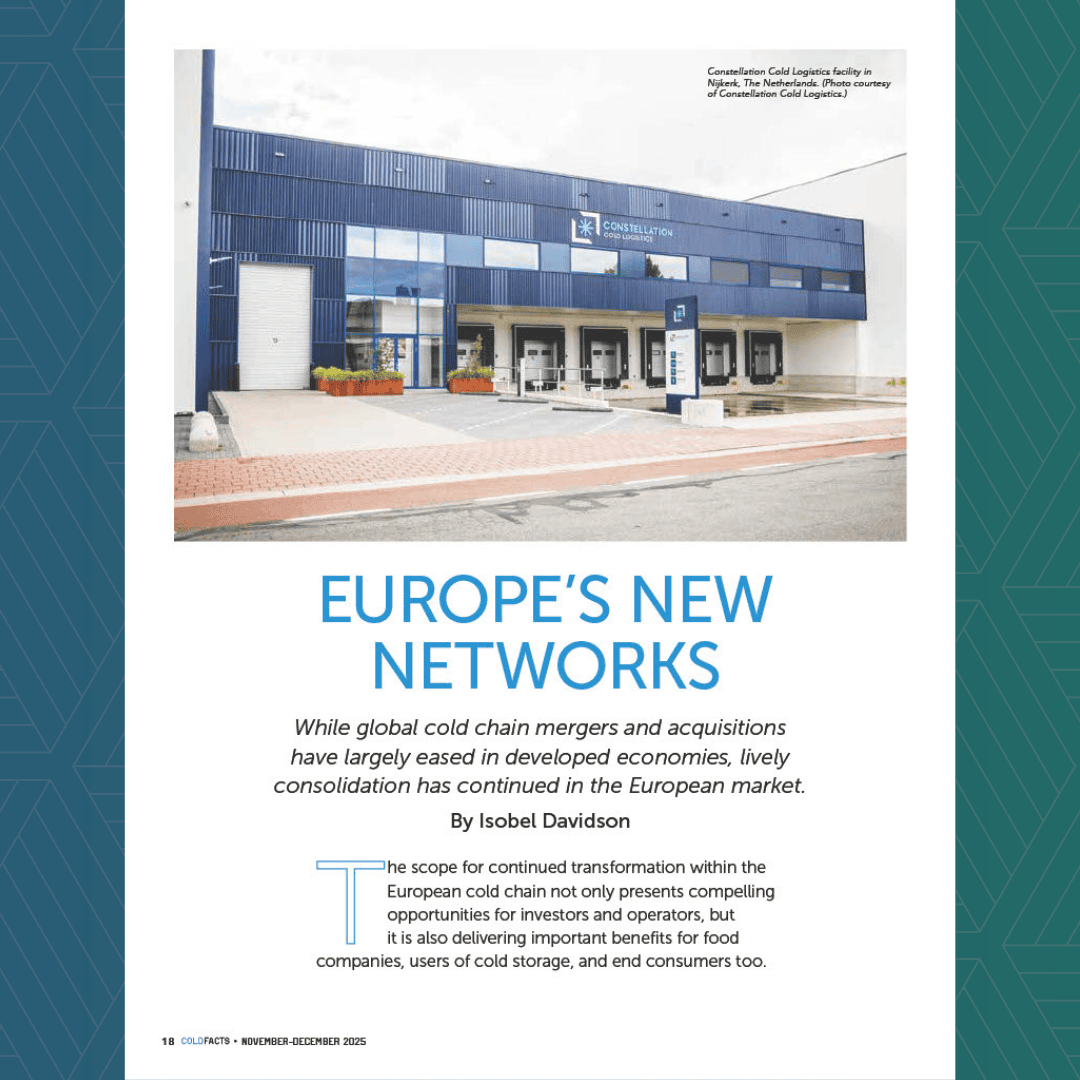
While global cold chain mergers and acquisitions have largely eased in developed economies, lively
consolidation has continued in the European market.
The scope for continued transformation within the European cold chain not only presents compelling opportunities for investors and operators, but it is also delivering important benefits for food companies, users of cold storage, and end consumers too.
Carlos Rodriguez, Chief Executive Officer at Constellation Cold Logistics, explains, “There is greater consistency, quality, and security for customers working with the same operator across different countries; and the economies of scale that are made possible can ultimately reduce costs for the end customer.”
Cold chain consolidation is important to sustainable and resilient food supply chains in a fast-changing world. GCCA Senior Vice President of Global Programs and Insights, Adam Thocher, says, “More connected networks mean more efficient movement of food at regional and global levels; and greater resilience when faced with change and disruption.”
Consolidation Leaders: UK and the Netherlands
Over the past decade, the European cold storage market has seen international platforms pursuing significant buy-and-build strategies. As a result, they have successfully accessed new markets and scale advantages such as process standardization, centralization, and enhanced customer reputation.
However, Europe’s cold storage industry remains only partially consolidated. Analysis by global strategy consultants OC&C has found that large international platforms control roughly half of the total outsourced market capacity. At the same time, founder-led independent operators still hold around 35% to 45% of total capacity (and approximately 50% to 60% share of individual facilities).
A key reason why Europe’s cold chain consolidation historically trailed that of other developed economies, says Thocher, is that the many borders between Europe’s 44 countries have made consolidation less straightforward. “But businesses, markets, and processes are now ready,” says Tocher. “At the same time, similar to the United States over the past decade, there is a swathe of family businesses in Europe that is starting to look to the next chapter.”
Growth Opportunities: Southern and Eastern Europe
OC&C’s research found that in larger and more mature European markets, such as the Netherlands and the United Kingdom, founder-led independent operators only control 25% to 35%, and major operators control 45% to 55% of total outsourced cold storage capacity. Many Southern and Eastern European markets remain in earlier stages of consolidation – in Czechia, large international businesses control as little as 10% of capacity.
The opportunities these numbers indicate for further merger and acquisition activity in Europe are exciting, but a strong sense of caution remains.
Thocher says, “While Europe has a low risk profile, the high level of uncertainty felt currently throughout the world is present in Europe, too. Pace of consolidation is much faster in Europe than anywhere else now, but it is still tempered sensibly by uncertainties about how the cold chain will be affected by changes to global trade because of ongoing geopolitical tensions within Europe, and by the impacts of climate change.”
OC&C Partner Casper Roex reiterates this sense of tempered growth and says, “While the industry continues to grow as a whole, there are pockets in the market where demand for cold storage is decreasing. This is primarily the case with red meat, where changing consumer patterns and government regulation are affecting processing volumes.”
The Evolution of Buy-and-Build Platforms
The profile of the consolidation activity now taking place in Europe is evolving. OC&C analysis reports that recent activity driven by U.S.-based consolidators has slowed, overtaken by newer buy-and-build platforms such as Constellation and CubeCold, and by organic expansions, such as NewCold.
Roex says, “Businesses based in the United States have shifted gears in Europe from active buy-and-build to managing the existing portfolio. This is mainly because they have focused on other things or other regions in the world. It is not unthinkable that they might return to a buy-and-build strategy in Europe in the future. On the other hand, the PE-backed platforms, Constellation and CubeCold, have been active, and One Frio, a new platform, has recently emerged.”
Notable activity in 2025 includes NewCold’s acquisition of Wilhelm Schüssler Spedition GmbH, a logistics and integration specialist in Heppenheim, Germany; CubeCold’s acquisition of cold storage operator SG in Northern Italy, and storage and packaging business Sivafrost in Belgium; and Constellation Cold Logistics’s expansion in the Netherlands through the acquisition of family-run coldstorage provider Lau van Haren, and in Denmark through the acquisition of the main cold store of JN-Spedition East located in Køge.
For Carlos Rodriguez, Constellation Cold Logistics is nearing the completion of its core foundation with regard to geography, type of services, commodities, and mix of conventional and fully automated cold stores. He explains, “Constellation is in eight European countries today, within the next year we expect to be operating out of 10 or 12 countries. As we look to double the size of the business over the coming five years, that growth will probably take place within those 10 to 12 countries.”
Strategies have become more focused, says Thocher: “The distinctions between different European nations, and variations between different European markets, mean that networks are competing for the particular market that best suits their operations and business plans rather than focusing predominantly on size.”
Another adjustment in the profile of Europe’s consolidation activity is that the implementation of mergers and acquisitions in Europe is generally taken more slowly. Focus has increased on retaining an acquired firm’s personal connections with employees, customers, and local communities.
Rodriguez sees this as a differentiator for Constellation, and crucial for any cold chain operator’s success in Europe, “Respecting the differences between every European country is a main focus for us. The same customer may have different needs for the different countries in which they operate. Ensuring that we can function as one company, while respecting local requirements, applying local expertise and empowering teams, is a key challenge but also our biggest opportunity.”
The profile of merger and acquisition activity in Europe is expected to continue to evolve in the coming years. OC&C reports that while approximately 40% of market capacity is in the hands of small independent operators across Europe, in countries such as Italy and Spain, that figure is even higher. It expects investor focus to shift towards these and other underpenetrated markets, where the potential for platform-building and regional roll-ups remains high.
“The northwestern European markets have been materially ‘grazed’ by consolidators,” Roex explains. “While acquisition candidates are still available, picking the winners is becoming increasingly difficult and expensive. Southern and Eastern Europe are more fragmented and less touched, so they hold more opportunity for buy-and-build in the future.”
Thocher foresees that in the future, Europe’s temperature-controlled logistics networks will increasingly look beyond continental borders, driving improvements in end-to-end supply chain efficiency to everyone’s benefit. “Greater collaboration across the cold chain supports better policies, better opportunities, safe and efficient trade, greater efficiency and sustainability.”
Contact Us
COLD FACTS Magazine and media inquiries: Lindsay Shelton-Gross, Senior Vice President, Global Communications, Marketing and Strategic Initiatives, Global Cold Chain Alliance
Editorial Ideas: Please contact Editor-In-Chief Alexandra Walsh
Advertising Opportunities: Contact Jeff Rhodes, Vice President of Sales, MCI USA Sales