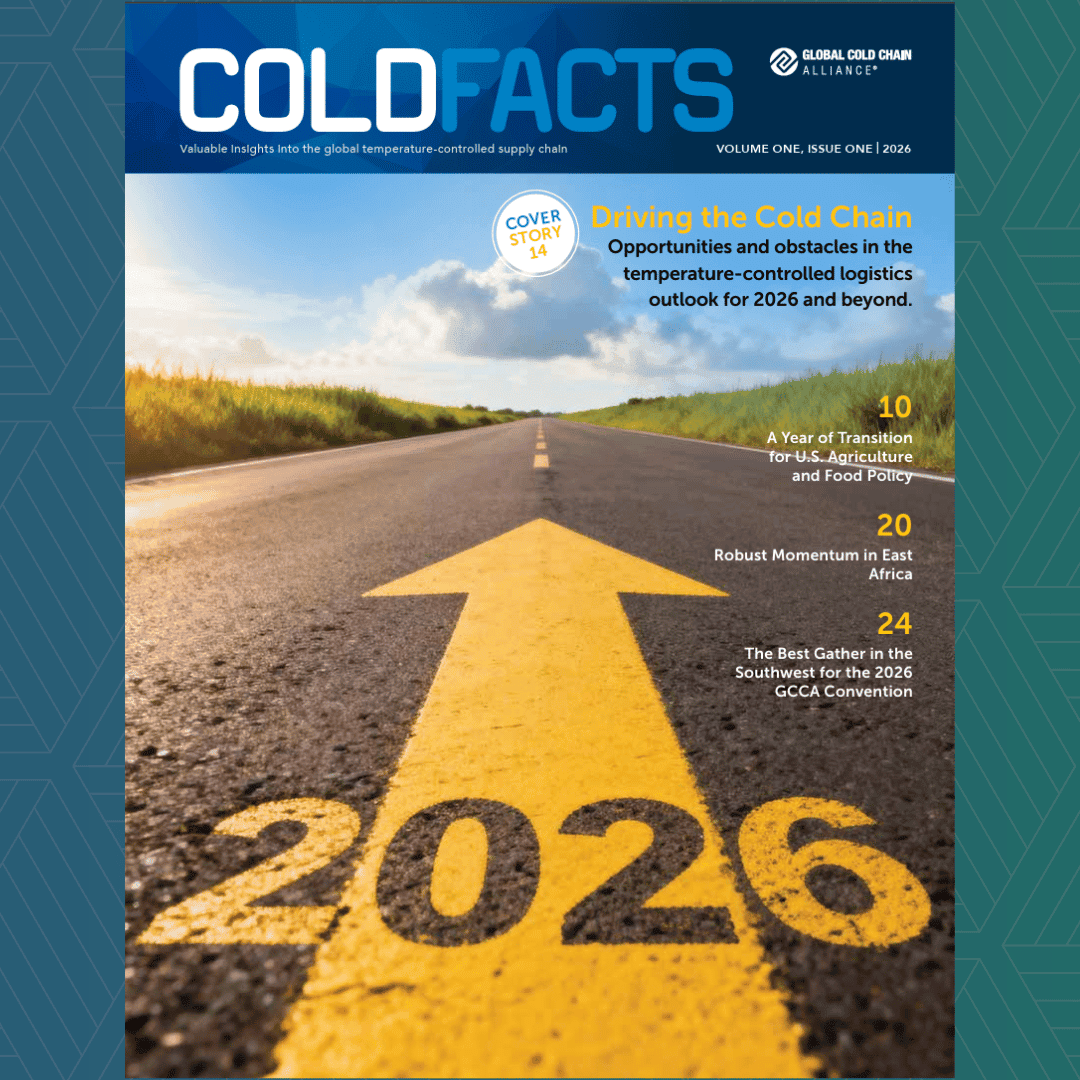
Cold Facts Magazine
Modernizing Global Food Trade in an Era of Instability

Global trade hasn’t just been in the headlines this year – it has defined them.
Amid this turbulence, countries are searching for a new balance: protecting economic resilience at home while ensuring their industries can still compete and grow overseas.
It’s not an easy equation to solve. Yet the conversations we’ve been having with policymakers across multiple regions offer grounds for cautious optimism. In meetings, we’re seeing a real appetite for practical, workable reforms that remove friction from trade. This is driven in part by the hard realities facing governments. Public budgets are tightening, skilled regulatory staff are in short supply, and agrifood inspection systems in many places are under strain. These pressures are accelerating the demand for more innovative, modern approaches.
For GCCA, this moment represents a significant opportunity. As governments seek solutions that both strengthen oversight and support commerce, we are helping shape opportunities for innovation within the bureaucracy that governs food trade. We are making the case for a system based on robust processes that are more efficient, more resilient, and better aligned with the needs of a rapidly changing world.
Digitization and Trust: Global Priorities
Anyone who engages in the food trade knows the red tape can be burdensome. Beyond routine customs procedures, agricultural goods must navigate an additional layer of bureaucracy focused on food safety and consumer protection. These requirements fall under the Sanitary and Phytosanitary (SPS) controls, which govern the movement of animal and plant products worldwide.
SPS systems are highly technical, sensitive, and long overdue for modernization. These paper-heavy processes create delays, cost money, and invite fraud. It is why, despite persisting political tensions, meaningful progress continues in the effort to standardize and digitize the documentation that underpins international food trade.
One of the strongest examples is the International Plant Protection Convention’s (IPPC) e-Phyto Solution, which enables countries to exchange digital phytosanitary certificates through a centralized hub. As of September 2025, 96 countries are regularly using the digital platform, with traders reporting savings of more than $80 million due to reduced paperwork and delays. It has taken years of effort, but the impact on the plant trade is real, as are the faster movement between markets and fewer administrative headaches.
Digitization of meat and dairy products is progressing too – but at a slower and more complicated pace. Unlike plant health rules, which fall under one global treaty body (IPPC), animal health rules are spread across multiple international organizations, including the World Organization for Animal Health (WOAH) and the Codex Alimentarius.
Certification requirements for animal products also vary widely, from live animals to seafood to processed meats, each with its own risk profile and certification requirements. And because animal products pose higher perceived risks to public health and national biosecurity, governments are cautious about standardization.
Paper documentation and human inspections continue to be the longstanding and trusted way to protect borders. It takes a lot of work and a lot of proof to open minds to the possibility that digital systems can offer more accurate processes and better food traceability.
Even with these complexities, there is progress. WOAH is exploring the development of a global hub for digital veterinary certificates modeled on e-Phyto. Achieving this will take time, but the benefits could be substantial with lower costs, faster processing, improved trace-ability, and stronger safeguards against fraud.
Bilateral Innovation: Reducing Red Tape
While global work continues, several countries are advancing reforms at the national and bilateral level. A significant example involves the long-standing requirement that veterinary certificates carry a physical “wet” signature from a qualified certifying officer. This rule remains in place across much of the world and is one of the biggest barriers to modernization.
But things are beginning to change. Australia and New Zealand have negotiated bilateral acceptance of digitally signed veterinary certificates. The European Union has invested heavily in its TRACES NT portal, which allows for e-signed certification. GCCA is advocating for these types of practical reforms, which cut costs and reduce delays for cold chain operators.
These incremental steps matter. Over time, they help shift regulatory systems from exclusively in-person oversight to digital supervision and remote verification, changes that many governments increasingly view as necessary due to budget constraints and staffing shortages. Governments know they need innovation, not least because they increasingly can’t afford or find the people for the regulatory oversight jobs.
In recent discussions with senior Canadian officials, it was clear how much pressure they feel to reduce administrative burdens tied to veterinary certification. Canadian cold chain companies are playing a leading role in testing digital oversight models that could become gamechangers if regulators accept them.
In 2026, accelerating digitization remains a core global priority for GCCA. The Alliance continues pressing for progress in international forums, while also working country by country to remove bottlenecks, reduce costs, and strengthen certainty in the movement of goods worldwide.
Trusted Partners: Rebuilding Confidence in the Cold Chain
The second major theme shaping 2025 is trust – specifically, how governments view cold chain facilities within the import and export system.
Certification and clearance processes for high-risk food products are designed with caution in mind. Their core purpose is to protect public health and national biosecurity, as well as deter fraud. But there’s a smart way to do this— targeted, risk-based, intelligently-led—and a less effective way that creates delays, adds cost, and still fails to stop bad actors.
Brazil: Overcoming Regulatory Barriers
The experience of cold chain businesses in Brazil illustrates this tension. Current regulations largely prevent third-party cold warehouses from storing meat products des-tined for export after they leave the production facility. In most countries, this type of interval storage is a standard, essential service. Blocking it is both discriminatory and unnecessary.
This problem became more pressing during the recent outbreak of Avian Influenza H5N1 in the Rio Grande Do Sol region. Poultry exports to key markets, including China, were temporarily halted, forcing large volumes of frozen chicken to sit in refrigerated containers for weeks. This is expensive, energy-intensive, and potentially unsafe.
Thanks to persistent advocacy by GCCA Brazil members, attitudes inside Brazil’s Agri-culture Ministry (MAPA) are shifting. There is increasing optimism that the role of third-party cold storage will be formally recognized – an important step toward building a more resilient, efficient export system.
United States: Reducing Reinspection Burdens
While U.S. warehouses do not face the same structural barriers as Brazil, they do encounter significant duplicative reinspection requirements. The GCCA’s U.S. Government Affairs Committee is leading efforts to streamline these rules.
Today, many third-party facilities must wait for federal inspectors to “recertify” goods already inspected at the production plant simply because they moved locations. This adds cost, creates delays, and strains an already overstretched federal inspection agency.
GCCA’s Trusted Partner initiative aims to streamline these requirements by recognizing the reliability of compliant third-party facilities. The potential benefits are clear: reduced costs for exporters, fewer delays, more efficient use of federal inspection staff, and strengthened global confidence in U.S. meat exports. Early conversations with USDA and the Food Safety and Inspection Service have been constructive, and progress is anticipated in 2026.
Looking Ahead
While trade policy debates and tariffs dominate the global conversation, the foundation of a competitive, resilient food export economy lies in the logistics operations that move goods safely and efficiently around the world.
GCCA remains focused on the practical, solutions-oriented work that moves the needle: advancing digitization, cutting unnecessary costs, strengthening trust in cold storage facilities, and breaking down the regulatory barriers that slow or block food exports.
These changes may not always make headlines, but they support the economic growth and market access that agricultural producers seek. We will continue to position the global cold chain not just as a service provider – but as an essential partner in sustaining and growing the world’s food trade.
Contact Us
COLD FACTS Magazine and media inquiries: Lindsay Shelton-Gross, Senior Vice President, Global Communications, Marketing and Strategic Initiatives, Global Cold Chain Alliance
Editorial Ideas: Please contact Editor-In-Chief Alexandra Walsh
Advertising Opportunities: Contact Jeff Rhodes, Vice President of Sales, MCI USA Sales