Cold Facts Magazine
Robust Momentum in East Africa
The Cold Chain May Be on the Cusp of a Step Change
Although still constrained by fragmented infrastructure and high operational costs, the region’s urban hubs are now experiencing a rapid, strategic expansion of the temperature-controlled logistics network.
In late 2024, GCCA Director for Africa Paul Matthew convened a series of engagements and facility tours in Kenya. He reports, “There is exciting and robust momentum in the expansion and development of East Africa’s cold chain. Significant investment is coming into the industry, and the results are very impressive: efficient new facilities, modern technologies, a strong range of services available to meet customers’ needs, and serious future plans.
“This surge in temperature-controlled logistics capabilities and capacity is set to reduce the region’s post-harvest losses, improve sustainable food security, increase export competitiveness, and support effective healthcare,” Matthew notes.
Dr. Newton Matope agrees. He is chief executive officer at temperature-controlled storage facility and logistics provider Cold Solutions and is GCCA Africa Council Chairman for 2026. He says, “The development of cold chain infrastructure in East Africa has evolved from isolated, donor-driven projects to strategic, market-led investments. The key economies of Kenya, Tanzania, Ethiopia, Uganda, and Rwanda are focused on creating integrated logistics ecosystems.
“Investment in refrigerated warehouses and storage facilities in Nairobi, Tatu City, Dar es Salaam, Kampala, Kigali, and Addis Ababa is driven by both domestic businesses and foreign investors,” Matope continues. “Governments are also playing a crucial enabling role through public-private partnerships. Kenya’s expansion of the Mombasa Port and the development of the Naivasha Inland Container Depot are prime examples.”
Over the past three years, private equity investment firm ARCH Emerging Markets Partners has launched three temperature-controlled logistics assets in the region through its Cold Chain Solutions East Africa Fund.
ARCH’s flagship site for Kenya and East Africa is a 15,000 pallet, LEED Gold certified facility in Nairobi that was constructed on a six-acre greenfield site within the Tatu City Special Economic Zone in Kiambu County. It provides temperature-controlled storage and distribution for key sectors such as agriculture, fast-moving consumer goods, pharmaceuticals, quick-service restaurants, and the protein market for local and regional clients. This facility is complemented by a 3,000-pallet, temperature-controlled warehouse in Kampala, Uganda, and a horticulture packhouse in Kigali.
Construction is also underway for ARCH’s new 8,000 pallet temperature-controlled facilities in Kampala, Dar es Salaam, Mombasa, and Kigali, which are due to launch from late 2026 through 2027. ARCH Managing Director Frederick Kambo explains why the region’s cold chain is a core focus for investment.
“East African food and agriculture have a significant problem with 30% to 50% of food lost post-harvest,” says Kambo. “A main cause is the lack of cold storage and logistics infrastructure in the region. We would like to make a meaningful contribution to addressing food loss and food security, and in doing so, we also anticipate commercial returns as a private sector investment firm.”
The commercial case for cold chain investment in East Africa has become increasingly attractive. According to Dr. Matope, the convergence of export ambitions and domestic consumption shifts is driving demand for cold chain services.
“East Africa is now a leading exporter of flowers, French beans, avocados, aquaculture, and specialty coffee,” says Dr. Matope. “The logistics to export this produce need to comply with stringent E.U. and U.K. supermarket standards on temperature control and traceability. At the same time, urbanization and a burgeoning middle class are shifting consumption patterns. The region’s growing hospitality and retail sectors are also contributing to the rising demand for cold storage and transportation, particularly for perishables like meat, seafood, dairy, and frozen goods.”
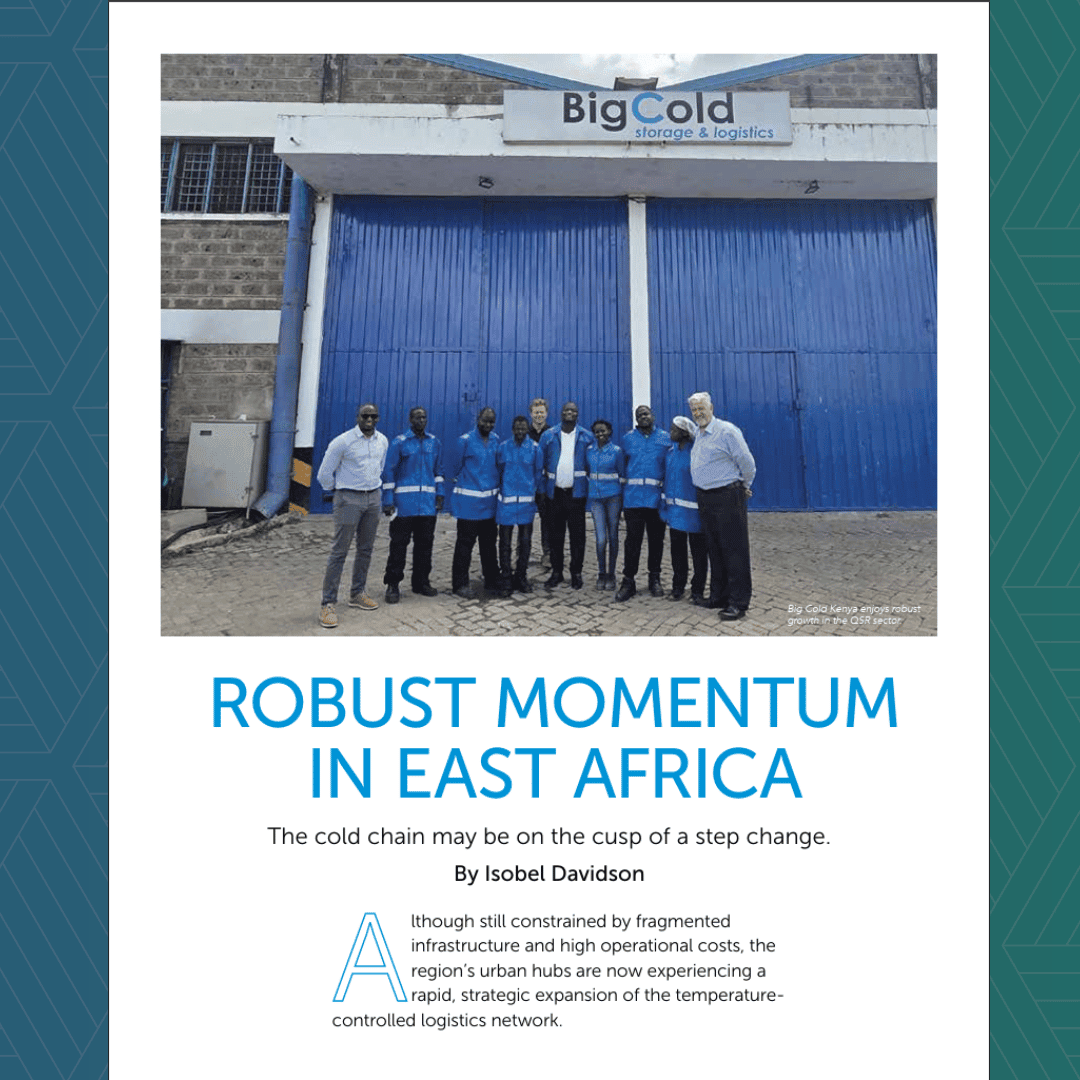
Peter Juma, Director of Operations at cold chain logistics company BigCold Kenya, notes robust growth in the region’s QSR sector attributed to the ease of opening businesses, a growing middle class, and demand for quality products from a population informed by globalization.
“The regions cold chain industry has been growing steadily to meet demands in food safety, capacity, and logistics,” says Juma. “In 2018, we only had one cold chain facility in both Kenya and Uganda. Currently, we have four operators in Kenya and two in Uganda. This growth has been primarily driven by international QSR brands that demand high-quality cold-chain services. We can expect this trend to grow in the coming years with the various entrants currently setting up in the region.”
Dr. Matope agrees there is great potential for cold chain growth in the region as there is a gap in the market for integrated 3PL and 4PL providers that can offer end-to-end visibility and management, as well as “immense untapped potential in providing scalable, modular cold storage and pre-cooling solutions at the collection point, empowering smallholder farmers and reducing initial quality loss,” says Dr. Matope.
The striking opportunities are, however, tempered by significant challenges. Regional 3PL cold chain pathfinders such as ARCH are educating the market. At the same time, infrastructure deficits, including road network limitations, remain a barrier. The cost of setting up cold chain facilities is high, and there is a shortage of skilled technicians for specialist temperature-controlled logistics operations and maintenance.
It’s encouraging that innovations and advanced technologies that will help the industry move beyond many of these challenges are being embedded in facilities and processes as the region’s cold chain network expands.
Use of solar technology is a prime example. ARCH’s state-of-the-art Tatu City facility sources up to 40% of its energy needs from off-grid renewable power production, mainly using solar photovoltaic energy. Solar technologies are being applied on a smaller, localized scale as well.
“With the current challenges of setting up operations and high post-harvest losses, the creation of smaller solar-powered cold chain centers has been a game changer,” says Juma. “It has brought cold chain services closer to the farmers.”
Cold chain facility design and operation in East Africa are adapting global technologies to forge the resilient, sustainable, and customizable cold chain model needed in the region.
“IoT-enabled sensors and data loggers are becoming standard for premium exports and pharmaceuticals, providing real-time monitoring and creating a digital audit trail,” says Dr. Matope. “Cold Chain-as-a-Service (CCaaS) models are enabling SMEs to tap into shared, scalable cold storage and transport networks. And while electric refrigerated trucks face range limitations, they are finding a strong niche in urban last-mile distribution.”
With the promise of increased intra-African trade through the African Continental Free Trade Area, and as shifting global trading patterns offer potential new opportunities, investors and operators in the region are clearly looking to the technologies, facilities, and services that will provide for the region’s needs today and into the future.
GCCA is supporting cold chain growth in East Africa by facilitating knowledge sharing and networking, and by providing key insights and guidance. GCCA is also engaging with governments and regional development agencies to promote policy environments in East Africa that encourage and enable cold chain investment and growth. Find out more at www.gcca.org/regions/africa.
Contact Us
COLD FACTS Magazine and media inquiries: Lindsay Shelton-Gross, Senior Vice President, Global Communications, Marketing and Strategic Initiatives, Global Cold Chain Alliance
Editorial Ideas: Please contact Editor-In-Chief Alexandra Walsh
Advertising Opportunities: Contact Jeff Rhodes, Vice President of Sales, MCI USA Sales