

April 5, 2026 | 3:00 PM
Global Government Energy Interventions — Iran War Fuel Crisis
Following the joint Israeli-U.S. strikes on Iran beginning on February 28th, 2026, the explosive conflict has effectively shut maritime traffic through the Strait of Hormuz, the important global shipping lane through which 20% of global oil trade flows. The conflict has only continued to escalate and expand over the course of a month, leading to widespread disruptions of maritime traffic, oil availability, and energy markets. As of March 31, 2026, the price of Brent crude has jumped a record 64% in the course of a month, and global diesel and gasoline prices have followed suit. Immediate impacts are the strongest across Asia, which relies heavily on petroleum exports from the Persian Gulf. Emergency stockpiles across Asia are being opened, with only Japan, South Korea, and China having stockpiles large enough to continue normal economic activity beyond 100 days without new supply. Diesel price caps, fuel tax adjustments, export limits and fuel rationing are coming into effect across the region, with the Philippines being the first country to declare a national energy emergency over the supply shock.
As the conflict continues, these effects will continue to ripple across the globe, with Africa and Oceania being the next regions to face increased energy insecurity as the closure of the strait continues, and Europe’s energy situation will continue to deteriorate the longer the conflict drags on. Asian economies are shuttering refinery exports while petroleum flow typically bound for Africa, Oceania and Europe is being diverted to the east as prices in the Asian region continue to rise higher. The US, with strong domestic production, is likely to be cushioned from the supply impacts of strangled production, but large price increases as a result of the market disruption are likely to continue increasing the strain on consumers and the supply chain.
Expected interventions vary by the severity of the supply shock and the individual country’s access to reserves and alternative sources. More direct interventions are most widespread in Asia, where the supply shock is hitting hardest, and broader reserve releases have been the focus of top economies and producer-country responses. The largest global response has been a record release of strategic reserves, with countries across the globe contributing to a total 400 million barrel release. Countries across Asia have put in place petroleum export restrictions or taxes, with China and Thailand suspending fuel exports within days of the conflict’s start, and much of Asia has begun implementing voluntary travel reductions, carpooling measures, and closure of offices or a move to remote work with the goal of reducing consumption. More measures that are beginning to spread beyond Asia include slashing tariffs, loosening of fuel standards, and tax reductions to offset the strain placed on domestic consumers and address rising fuel costs. More drastic actions, such as fuel and electricity rationing or mandated blackouts, are yet to become widespread, but fuel rationing has already been imposed in some countries, such as Slovenia, Bangladesh, and Egypt.
The GCCA is closely monitoring the situation and engaging with key supply chain resilience forums across numerous markets. Senior Vice President Shane Brennan recently presented on cold chain impacts in Europe to the emergency food supply chain forum in Brussels. For more details, please contact sbrennan@gcca.org.
Specific actions taken by governments and multilateral bodies through March 31, 2026, in response to the Strait of Hormuz closure and resulting global fuel and diesel shortages. Grouped by region.
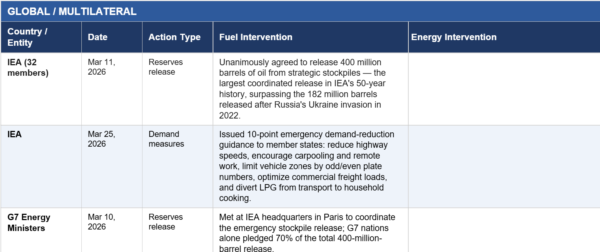
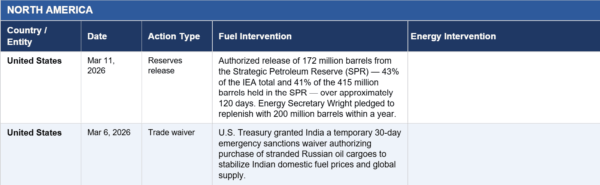
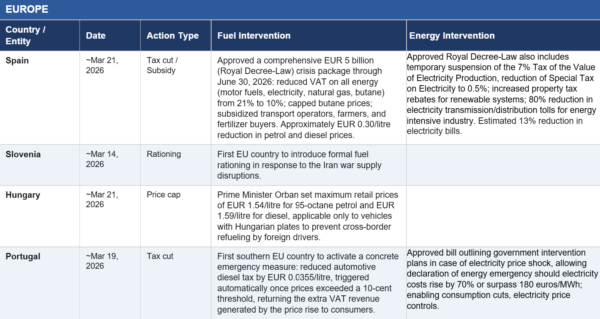
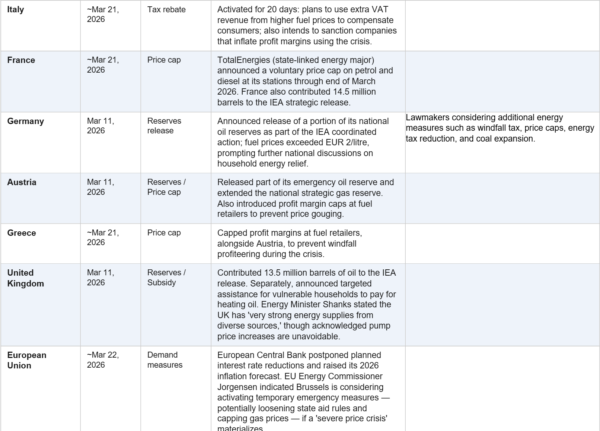
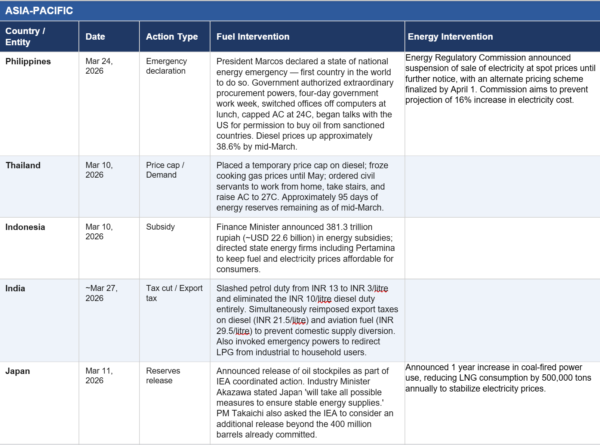
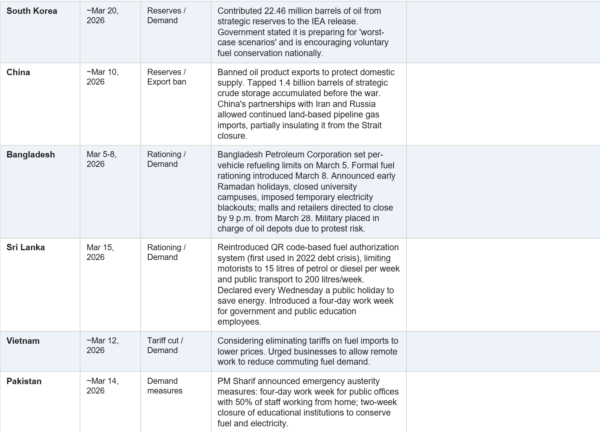
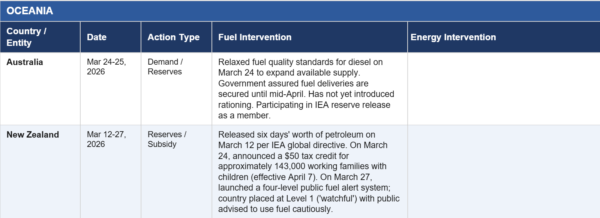
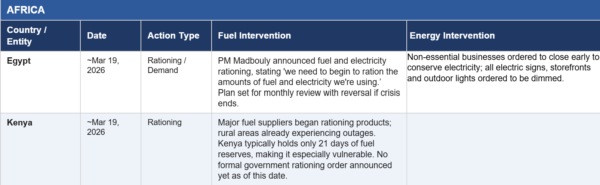
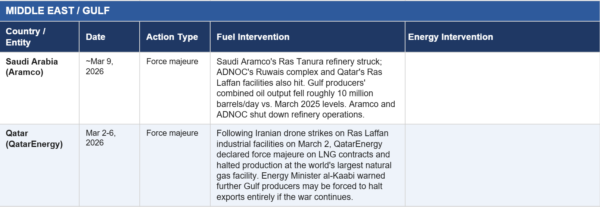
Note: Dates marked with ‘~’ are approximate based on available reporting. This table will require frequent updates as the situation is evolving daily. Diesel availability and pricing represents the most critical near-term operational concern for temperature-controlled logistics operators.
Published Date
April 5, 2026
Topic
Cold Chain Development, Energy, Government & Regulatory Affairs, Insurance & Risk Management, International, Legal Issues, Supply Chain Operations, Sustainability, Transportation & Logistics
Region
Africa, Asia-Pacific, Australia, Canada, Central & South America, Europe, Mexico, United States
Sector
GCCA Transportation, GCCA Warehouse, Global Cold Chain Foundation