Cold Facts Magazine
Investors Are Bullish on Ports
In Latin America and around the world, private capital is expanding and modernizing port infrastructure and services.
With access to both the Atlantic and Pacific Oceans, efficient multimodal transport connections, and competitive shipping costs, Latin America is a critical link in the global food supply chain. Private capital is driving very significant expansion and modernization of port terminals, logistics platforms, and connected cold chain infrastructure.
Driving Growth in the Temperature-Controlled Supply Chain
This trend is bringing clear changes for the temperature-controlled supply chain. Bruno Vargas, Operations Manager at a cold storage facility located at Portonave, the first private container terminal located in Brazil, says, “Over the last decade, and especially in the past few years, we’ve seen significant private and public investment in port infrastructure across Latin America, and that is clearly impacting cold chain operations. These investments are modernizing terminals, expanding container capacity (including reefer capacity), reducing turnaround times, and improving hinterland connectivity.”
Brazil’s Strategic Infrastructure Pivot
Vargas says in Brazil alone, there are strategic port infrastructure programs with billions of dollars allocated to modernization and logistics access improvements. Portonave is controlled by the Swiss group Terminal Investment Limited (TIL/MSC), and its cold storage facility is the only one in the country located directly within a container terminal. Portonave has significant private investment totaling approximately R$2 billion, to modernize its quay and acquire new equipment.
Mexico and Central America: Managing Saturation
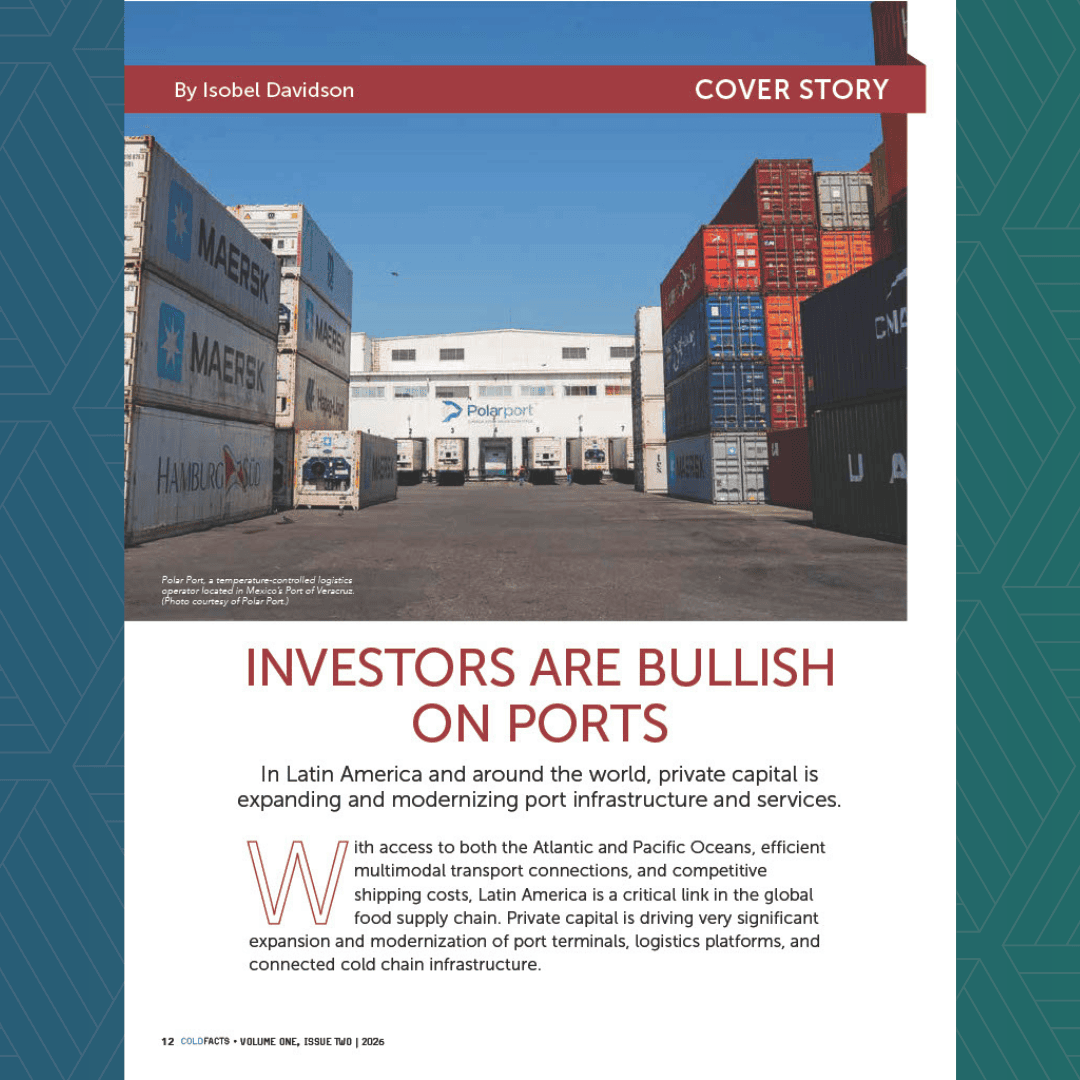
Abel Fernández Burgos, Reparación Integral de Contenedores and Polar Port, a temperature-controlled logistics operator located in Mexico’s Port of Veracruz, agrees. “Infrastructure is essential for efficient operations, and last year there was saturation at several port terminals. As in any market, saturation tends to trigger investment, expansions, and new capacity.”
As a result, users now have more options, even among ports located in the same region, Fernandez says. He offers good examples in the Gulf of Mexico are Altamira versus Veracruz, and in Central America, Santo Tomás de Castilla versus Puerto Cortés in Guatemala and Honduras.
Major Port Investments Across the Region (2025-2027)
Investment in Brazil’s ports is particularly high profile, and the Brazilian government has stated its goal of expanding private investment in ports. It intends to auction the Port of Santos’ new mega-terminal Tecon 10 in April 2026, for a 25-year concession period. The investment is intended to increase the port’s capacity by 50%.
In November 2025, DP World announced an investment of $275 million to expand cargo handling capacity, including infrastructure for refrigerated cargo, at Port of Santos.
Elsewhere in Brazil, a new $175 million private investment in the Rio Brasil Terminal at the Port of Rio de Janeiro was announced in 2025. It is expected to increase capacity by more than 70% by 2029.
This investment is reflected across the region. In 2025, APM Terminals announced a $550 million investment to expand Peru’s Callao port in 2026-2027. And Tisur, concessionaire of Peru’s Matarani Port Terminal and subsidiary of BlackRock-backed port operator Tramarsa, announced a $700 million investment to expand operational capacity and strengthen the competitiveness of the country’s main southern port.
In Mexico, a major base for nearshoring, the Nuevo Manzanillo project will more than double the port’s capacity by 2030, and will be funded by a mix of private and public investment. And last year, DP World pledged a $760 million investment aimed at enhancing the Dominican Republic’s Port of Caucedo and its Free Trade Zone.
Unlocking Opportunities for Cold Chain Operators
The profusion of expansion and modernization is unlocking new opportunities for temperature-controlled logistics businesses. As Latin America’s exports of agricultural products and proteins continue to grow, the demand for cold storage and refrigerated transport is increasing.
“The biggest opportunity for cold chain operators in the region is the increased trade flow with alternative markets,” says GCCA Senior Vice President of Global Markets Adam Thocher. “Major investment in multiple ports means that more Latin American produce can be exported to the United States and Asia and, to a lesser extent, Europe. Increasing the capacity and efficiency of ports means that the cold storage industry really has the opportunity to service this growing export market.”
The cold chain is responding to this opportunity positively but with more caution than recent strategies in the United States and Europe, adds Thocher. “The risk profile in Latin American countries is higher, and businesses tend to go to where customers specifically need a cold storage solution.” Vargas notes he’s seeing more private investment in temperature-controlled warehouses located close to port areas to reduce dwell time and improve cargo integrity. With trade flows in Latin America becoming more complex and more global, cold chain operators are adapting by expanding capacity and geographic coverage.
Technological Integration and Automation
Vargas says, “Operators are investing heavily in technology and efficiency, including warehouse automation, digital temperature monitoring and traceability, and energy efficient refrigeration systems. These investments are essential because operating costs, especially energy, remain one of the biggest challenges in the region.”
Vargas says they are also seeing a closer integration between logistics providers, shipping lines, and exporters. “Many cold chain operators are evolving from pure storage providers into integrated logistics partners that manage transport, inventory, and export coordination.”
Polar Port’s response to the port-based demand increases of recent years includes expansion across borders and future-facing facility upgrades. “Since 2022, we have expanded our operations into Guatemala by establishing the first sanitary inspection facility of its kind at Santo Tomás Port. In Mexico, specifically in Veracruz, we have upgraded our port facilities to increase our operational capacity by nearly 40%,” says Fernandez. “At the same time, we are developing additional infrastructure outside the port area (within approximately eight miles), which will allow us to further increase capacity and diversify the range of services we offer.”
Looking to the future, the continued increase in demand from Asia, Europe, and North America for Latin American produce places cold chain logistics at the heart of the region’s export economy.
Vargas highlights several other developing opportunities for temperature-controlled logistics operators facilitated by investment in ports. “New port infrastructure and logistics corridors are improving connectivity, nearshoring and supply chain diversification are increasing trade volumes across the Americas, and technological modernization is allowing operators to improve efficiency and traceability. Operators that invest in infrastructure, digitalization, and energy efficiency will have a strong competitive advantage.”
Fernandez adds that he expects opportunity too in the connection between operations inside and outside the ports.
“As the industry gains more experience and market penetration improves, products will be less exposed to time disruptions. Commodities such as meat products will increasingly be delivered for a wider range of uses, including food service, processing, and ingredient supply chains,” Fernandez says. “Many ports in Mexico and Central America are located near medium-sized cities that also serve as connections to other consumption centers. Demand for cold chain services around port areas should continue to grow, particularly for activities such as product separation, picking, consolidation, and distribution.”
Navigating Challenges in the Latin American Market
There are challenges to address, too. Many Latin American countries continue to experience infrastructure gaps and port bottlenecks, energy costs are high, and climate and weather changes are increasingly affecting agricultural production and logistics networks. Policy changes require flexibility and adaptability: for example, while Mexico experienced double-digit growth in beef imports from South America in 2025, new measures implemented by the Mexican government this year to regulate the market and support domestic producers are expected to bring a significant decline in that segment.
GCCA is working to support members operating in Latin America with the latest information and analysis, with expert advice and guidance, and by creating the professional connections that support new opportunities and collaborative solutions. GCCA is also working to address the challenge that operators face through lack of understanding among some of the wider supply chain about the value of third party logistics (3PL) providers.
“We are working to help develop greater understanding about 3PL for producers and processors, demonstrating that 3PL makes their processes more efficient and cost effective while minimizing port congestion and helping manage disruption and change,” says Thocher.
Latin America is one of the world’s largest exporters of perishable food, and the private investment that drives port infrastructure improvements and capacity increases is boosting the perishable food supply chain not just in Latin America, but for the region’s trading partners around the globe. Visit www.gcca.org/events to find out about the GCCA events coming soon in Latin America.
Private investment in Ports Around the Globe
The influx of capital into ports as global supply chains are recalibrating has clear potential to drive changes in regional trade dynamics, and beyond.
Thocher says, “Strategic port investments are well underway almost everywhere around the world. Land for ports is finite, and port ownership is a matter of national security.”
The global picture of port ownership is mixed, explains Victor Shieh, Membership Outreach and Networks Director at the International Association of Ports and Harbors (IAPH). “In some regions like Latin America, there is a mix of national port administrations on one hand who put concessions out to tender, but also a large number of privately owned and run ports that also own the land. In other regions like in India, a recent call has been made to change the governance of ports from trusts to public port authorities, which does not mean private ownership, but will arguably allow for competitive tenders, which will mean greater incentive for investment.”
With a strong focus on developing premier assets and returning value, private capital in ports often drives early investment in automation, training, expansion, and maintenance.
“Private ports have a clear mandate for permanent, long-term investment. But private ownership also means less choice for shipowners, and a public port with different terminals may offer more options,” says Shieh. “In the case of public port authorities, in recent years we have seen longer concessions put out for tender, some exceeding 20 years, which are often demanded by candidates in order to commit to the necessary investments in port infrastructure, materials handling equipment and storage.”
The lack of competition created by a small number of international conglomerates operating the world’s ports brings risks too – commercial decisions or changes in relationships have the potential to upend global trading patterns and affect entire economies.
The flow of capital to ports is expanding and modernizing associated cold chain infrastructure. Thocher says, “People have become more aware of cold chains since the pandemic, and as ports are developed and improved we are seeing more specialized inspection points, more reefer points, more climate-neutralized environments, and more opportunities provided to cold chain operators inside of trade zones. Cold chain represents a small percentage of port throughput but there is high value placed on the produce inside the containers.”
The Shift Toward End-to-End Solutions
Temperature-controlled supply chain capacity is also being augmented by major liner shipowner-terminal operators such as MSC, Hapag Lloyd, Maersk, CMA-CGM and terminal operators turned end-to-end supply chain solutions providers such as DP World and PSA.
“They are investing in reefer containers, plugs and/or storage because for them, fresh produce is almost always high-yielding cargo,” says Shieh. He adds, “They are far more interested in having direct relationships with cargo owners than with their forwarder base, which is why many of them are putting their money on the table when it comes to private investment in specialized cold storage, intelligent containers with IoT tracking options for shippers, and other innovative supply chain technologies.”
Geopolitical turmoil is creating major disruption and uncertainty in the shipping industry, however investments in port infrastructure are long term by nature.
Shieh says, “Locations such as the Western Cape will always export high yielding fresh fruit and vegetable products from the Cape Town port or those close by; much as the Brazilians will always be exporting their poultry from the southeast coast of Latin or South America. That predictability over the long term plays an important role.”
_______________________________________________________________________________
Contact Us
COLD FACTS Magazine and media inquiries: Lindsay Shelton-Gross, Senior Vice President, Global Communications, Marketing and Strategic Initiatives, Global Cold Chain Alliance
Editorial Ideas: Please contact Editor-In-Chief Alexandra Walsh
Advertising Opportunities: Contact Jeff Rhodes, Vice President of Sales, MCI USA Sales