Cold Facts Magazine
AI is Transforming Cold Transportation
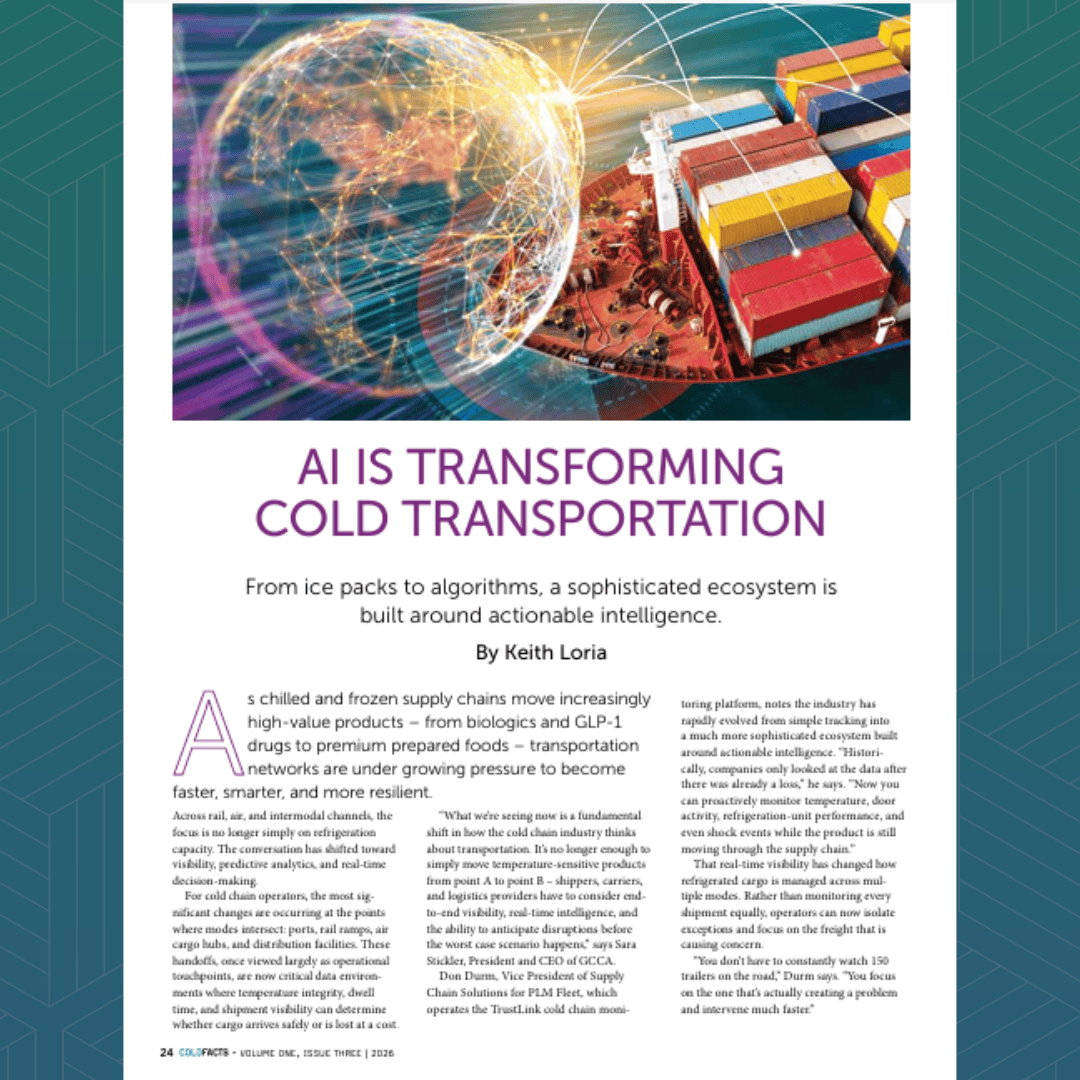
From ice packs to algorithms, a sophisticated ecosystem is built around actionable intelligence.
As chilled and frozen supply chains move increasingly high-value products – from biologics and GLP-1 drugs to premium prepared foods – transportation networks are under growing pressure to become faster, smarter, and more resilient.
Across rail, air, and intermodal channels, the focus is no longer simply on refrigeration capacity. The conversation has shifted toward visibility, predictive analytics, and real-time decision-making.
For cold chain operators, the most significant changes are occurring at the points where modes intersect: ports, rail ramps, air cargo hubs, and distribution facilities. These handoffs, once viewed largely as operational touchpoints, are now critical data environments where temperature integrity, dwell time, and shipment visibility can determine whether cargo arrives safely or is lost at a cost.
“What we’re seeing now is a fundamental shift in how the cold chain industry thinks about transportation. It’s no longer enough to simply move temperature-sensitive products from point A to point B – shippers, carriers, and logistics providers have to consider endto-end visibility, real-time intelligence, and the ability to anticipate disruptions before the worst case scenario happens,” says Sara Stickler, President and CEO of GCCA.
Don Durm, Vice President of Supply Chain Solutions for PLM Fleet, which operates the ColdLink cold chain monitoring platform, notes the industry has rapidly evolved from simple tracking into a much more sophisticated ecosystem built around actionable intelligence. “Historically, companies only looked at the data after there was already a loss,” he says. “Now you can proactively monitor temperature, door activity, refrigeration-unit performance, and even shock events while the product is still moving through the supply chain.”
That real-time visibility has changed how refrigerated cargo is managed across multiple modes. Rather than monitoring every shipment equally, operators can now isolate exceptions and focus on the freight that is causing concern.
“You don’t have to constantly watch 150 trailers on the road,” Durm says. “You focus on the one that’s actually creating a problem and intervene much faster.”
Rail’s Growing Role
While trucking still dominates refrigerated freight, rail operators are positioning themselves to handle more long-haul temperature-controlled cargo, particularly as intermodal networks expand and sustainability pressures mount.
Robert H. Fay, President of Florida Freezer and Executive Vice President of Seminole Gulf Railway, notes Class I railroads are continuing to invest in solutions.
“Rail carriers are enhancing their refrigerated container fleets to support intermodal service,” he says. “At the same time, the buildout of refrigerated boxcars is slower.”
He adds that many railroads still rely heavily on private refrigerated fleets operated by companies such as Lineage’s Cryo-Trans system or on dedicated services like Tropicana’s juice train.
“Short lines want to become more involved,” Fay says. “But many smaller operators simply don’t have the capital capacity to significantly increase the supply of refrigerated rail cars.”
However, technology has helped narrow one traditional advantage trucking once held over rail – shipment visibility.
“All the refrigerated fleets are GPS monitored, and most have live telematic sensors,” Fay says. “Trucks no longer have an advantage over rail in data collection and monitoring.”
That increased visibility is being driven in part by customers demanding more detailed shipment data. According to Fay, railroads have responded by improving customer-facing portals and digital access to shipment information.
“This has been building for years,” he says. “For the most part, it’s been addressed through customer visibility portals like ShipCSX.”
AI Moves Beyond Tracking
The next phase of the cold chain is not simply collecting data but interpreting it.
Durm notes that the biggest challenge today is that operators are overwhelmed by the sheer volume of information from modern telematics systems. “The raw data is overwhelming users,” he says. “You can end up with thousands of alerts, so people start turning them off.”
Artificial intelligence is beginning to solve that problem by adding context to the data rather than simply generating alarms.
“AI can look at a temperature drift, recognize a door opening, check the ambient temperature outside, evaluate dwell time, and review refrigeration-unit performance trends all at the same time,” Durm says. “That allows operators to understand whether something is actually wrong or whether it’s just a normal operational event.”
Rather than replacing operators, Durm believes AI will primarily augment human decision-making. “It’s really going to help remove the noise,” he says. “That means fewer spoilage events, fewer insurance claims, and better operational decisions.”
Nick de Klerk, senior director of TMX Transform, which advises food, grocery and pharmaceutical companies on cold chain optimization, notes many organizations are moving away from reactive supply chain management toward predictive operations powered by connected data.
“Historically, demand signals were fragmented and pieced together with manual processes and spreadsheets,” de Klerk says. “As supply chains become increasingly connected through IoT sensors, big data, and AI-driven models, end-to-end visibility is improving.”
AI’s most immediate value, he adds, often lies in day-to-day execution rather than futuristic automation.
“In the warehouse, AI-driven machine vision is bridging the dexterity gap in piece picking,” de Klerk says. “In the office, it helps planners manage variables such as weather and geopolitical shifts in real time.”
Simulation and “what-if” modeling are also becoming important tools as companies evaluate potential disruptions before they happen.
“Simulation allows companies to identify congestion points and stress-test transportation networks before making major investments,” de Klerk says. “That’s becoming increasingly important as global trade lanes continue to shift.”
The Weakest Link
Despite improvements in monitoring technology, the industry’s biggest vulnerabilities remain at the transition points between transportation modes.
“The weakest link in the chain is still the handoffs,” Durm says. “That’s where most abuse happens and where the greatest risks exist.” He points to situations where refrigerated cargo sits too long at docks, ports or terminals awaiting transfer between systems. “You can have highly sensitive ice cream or biologics sitting at a dock and missing a delivery window,” Durm says. “That’s when temperature excursions start happening.”
Jim Jelinek, President of Roadtex, a 3PL that specializes in cold chain transport, sees similar risks. “The biggest challenges arise at the handoff points between modes, where systems don’t always connect cleanly,” he says. “Ports and rail ramps can introduce dwell time, increasing the risk of temperature excursions.”
The problem becomes even more significant as more biologics and pharmaceutical products pass through cold chain networks.
Compliance and Traceability Expand
The increasing value and sensitivity of refrigerated cargo are also accelerating regulatory pressure on traceability and documentation.
The Food Safety Modernization Act’s FSMA 204 rule is pushing companies to achieve much deeper visibility across the supply chain. These requirements extend beyond transportation providers to warehouses, retailers, and even restaurants. The ultimate goal is to improve recall response and isolate the product more quickly before it reaches consumers.
“If you know exactly where your product is, maybe it never enters commerce,” Durm says. “You can stop it while it’s still in the warehouse instead of recalling everything after it’s already in stores.”
Infrastructure and Resiliency
Pressures Beyond technology, infrastructure remains a major concern as trade disruptions and changing global supply routes reshape freight flows.
According to Americold, cold storage facilities located near ports, intermodal hubs, and major consumption centers are becoming increasingly important as operators work to stabilize temperature control amid disruptions and congestion. Americold noted that more than 90% of its facilities now capture real time utility and performance data to support predictive maintenance and provide networkwide visibility.
Fay believes rail investment will continue to grow despite policy uncertainty. “Rail will continue to expand its intermodal offerings because it remains one of the most efficient ways to move goods over long distances,” he says.
Trade tensions and geopolitical disruptions are also forcing companies to rethink flexibility.
“Policies in Washington, Ottawa, and Mexico City obviously affect planning decisions,” Fay says. “But rail continues to position itself for long-term opportunities across North America.”
Jelinek notes many cold chain operators are building more optionality into their transportation strategies. “Flexibility is now core to how networks are designed,” he says. “That means multi-port, multi-carrier and multimode options so shippers are not locked into a single path.”
Durm says retailers are also becoming a major force behind the adoption of monitoring and visibility technologies. Large grocery and retail chains increasingly want real-time location and temperature data integrated directly into their systems to better manage delivery windows and product quality.
“The big-box retailers want to know where the shipment is, when it’s arriving, and whether temperature integrity was maintained the entire way,” Durm explains. “That’s becoming a differentiator in the marketplace because consumers are expecting freshness and validation.”
Durm believes those demands will continue accelerating investment in connected cold chain systems that can track products seamlessly across multiple transportation modes and facilities.
The Future of the Smart Cold Chain
While AI remains in the early stages of deployment, many operators believe the industry is just beginning to understand its potential.
“There isn’t a single AI solution that solves everything today,” Durm says. “We’re still in the early stages of understanding how all of this works together.” Still, he believes the direction is clear. The future cold chain will rely on systems that connect fragmented transportation modes into a single, continuous source of truth.
“If you can’t see it and monitor it, you can’t improve it,” he says. “The companies that can connect all those handoffs are going to be the ones that succeed.”
“GCCA is working on new strategies to equip our members working in transport with the resources, connections, and knowledge they need to lead in this environment,” says Stickler. “Technology continues to advance rapidly, and we want to ensure our members have the right systems for the right job – connecting fragmented modes into a continuous, reliable backbone that commodities can depend on.”
***
Contact Us
COLD FACTS Magazine and media inquiries: Lindsay Shelton-Gross, Senior Vice President, Global Communications, Marketing and Strategic Initiatives, Global Cold Chain Alliance
Editorial Ideas: Please contact Editor-In-Chief Alexandra Walsh
Advertising Opportunities: Contact Jeff Rhodes, Vice President of Sales, MCI USA Sales