Cold Facts Magazine
Wait for the Strait
The impact of the spring disruption in the Gulf.
The outbreak of conflict between the United States-Israel and Iran in late February 2026, and the subsequent closure of the Strait of Hormuz, led to widespread global disruptions of maritime traffic, oil availability, and energy markets in March and April.
The immediate supply chain effects included MSC’s “end of voyage” declaration for all cargo under its custody bound for the Persian Gulf, discharging cargo at the next safe port for shippers to resume responsibility for the container. At the same time, maritime insurers cancelled war risk coverage for vessels operating in the Gulf.
Energy Insecurity
As disruptions to established shipping routes are expected to last well into the year, there are significant cost implications for fuel, particularly diesel, worldwide. GCCA’s member briefings reported in April that, second to the 18 • VOLUME ONE, ISSUE THREE | 2026 Middle East, the early fuel supply impacts were strongest across Asia. In parts of Asia, emergency stockpiles were opened, and diesel price caps, fuel tax adjustments, export limits, and fuel rationing came into effect.
Shane Brennan, GCCA Senior Vice President, Global Policy, Projects & Partnerships, says, “After Asia, the next regions expected to experience increased energy insecurity because of the closure of the Strait of Hormuz are Africa and Oceania. Europe’s energy situation will continue to deteriorate if the conflict continues. With strong domestic production, the United States is likely to be cushioned from supply impacts but can still expect large price increases as a result of market disruption.”
The consequences of the Strait of Hormuz closure are a clear demonstration of energy vulnerability. “Europe’s energy market has been more resilient in 2026 than during the major energy shock of 2022. This time, Asia has been particularly exposed,” says Brennan. “This spring has highlighted the continuing frailties of national, regional, and global energy systems. The business case for cold chain operators to improve energy efficiency and to invest in on-site energy generation is stronger than ever.”
Steering Through Turmoil
Throughout this period, supply chain professionals have once again drawn on experience, creativity, and strong relationships to steer through global turmoil.
Richard Winnall, President, International at Americold, explains the company’s approach. “Americold’s global network of cold chain solutions enabled customers to adapt quickly when critical trade routes and ports were disrupted. When one node was impacted, volumes could be redirected through alternative ports, facilities, and regions, helping maintain product flow and integrity. This combination of resiliency, creativity, and connectivity positioned Americold to support customers in navigating supply and demand shocks during a highly volatile period.”
The impacts of the conflict are also expected to have longer-term, system-wide implications. That shipping lines can abandon product is now a stark reality. The withdrawal of insurance remains a major issue, and a widespread reset can be anticipated when ships are unblocked. Impacts on food resilience will become clear over the course of many months.
“Customers are increasingly focused on resilience and contingency planning, including holding higher inventory levels and reducing reliance on single ports or routes,” says Winnall. “These events reinforced the value of optionality, flexibility, and a well-connected network across the cold chain rather than efficiency alone.
“During recent disruptions, cold storage played a critical role by allowing customers to hold inventory closer to market when fuel availability and transport routes were uncertain,” Winnall adds. “Investing in well-located, reliable facilities helps ensure essential food and temperature-sensitive products remain available, even when energy and logistics conditions are unstable.”
Visit the news section of the GCCA website to access GCCA’s regular briefings, including updates and analysis on the Middle East conflict disruption, and what it means for cold chain operators around the world.
RSA Cold Chain in Conflict
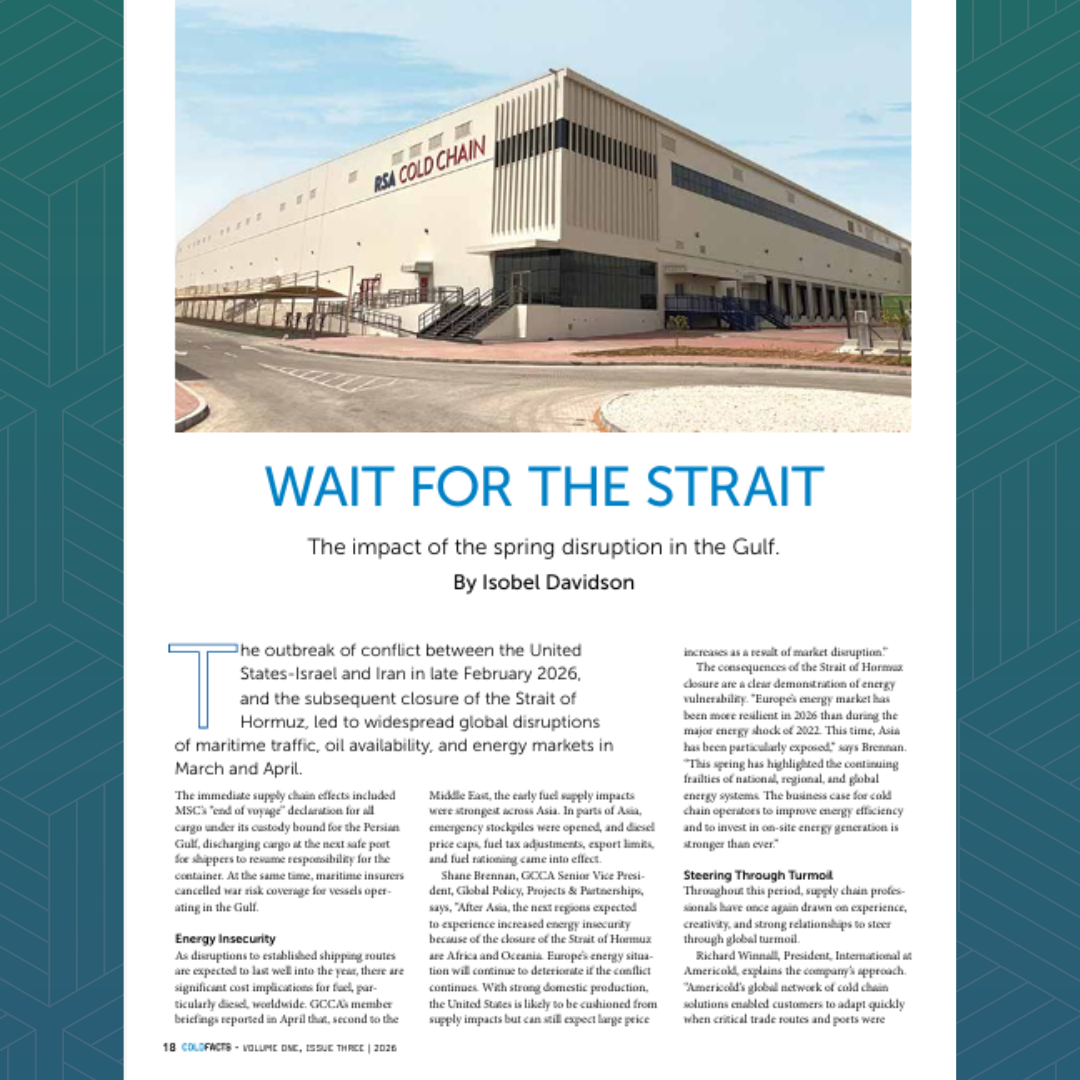
RSA Cold Chain, founded in the United Arab Emirates (UAE) in 2017 as part of RSA Group, became Americold’s partner representative for the region when Americold acquired a stake in the business in 2023.
RSA Cold Chain has grown rapidly in the past two years with significant investment in infrastructure. The business has expanded its Dubai South facility (located outside the bonded zone in the mainland) to 22,000 pallet positions across 10 chambers with variable temperature settings.
The company has also opened a new import/export hub in the Jebel Ali Free Zone (JAFZA) near Jebel Ali Port in Dubai, the largest port in the Middle East. This new facility has 40,000 pallet positions and offers both bonded and non-bonded temperature-controlled storage inside the port, managing mainland cargo as well as cargo for re-export.
The closure of the Strait of Hormuz abruptly halted the region’s cargo traffic. “Without port calls inside the Gulf, the flow to storage for consumption in UAE and for export to near markets was throttled,” says Brent Melvin, General Manager at RSA Cold Chain. “Vessels already at sea that were destined for Jebel Ali Port could no longer enter the Gulf, and insurers declined to ensure vessels that were going to navigate the Strait. Nothing could reach Jebel Ali, and cargo was offloaded at a range of other ports.”
Alternate Ways and Means
Melvin describes a quick and effective response from the UAE Government to the risk to national food security and sustainable operations. Three avenues of access were rapidly identified: the ports of Khorfakkan and Fujairah (which operate predominantly as an oil terminal) on the UAE’s east coast, and via neighboring Oman.
The UAE Government acted quickly to ramp up capabilities at the Port of Khorfakkan. Melvin explains that while rerouting so many vessels to Khorfakkan (previously destined for Jebel Ali) resulted in congestion and bottlenecks, the port quickly became key to bringing cargo into the region.
“Some operators also moved their cargo to the ports of Mundra and Nava Sheva in India,” Melvin adds. “UAE port operators arranged for feeder vessels to bring cargo from these ports to Khorfakkan. Road transport businesses rallied to ensure vehicles were lined up to bring containers from Khorfakkan to Dubai. There was more congestion on the roads to Dubai and more bottlenecks, but these alternatives ensured products were coming into the UAE and entering the region’s logistics network.”
Green Corridor
As well as meeting the logistics needs of customers bringing products into Khorfakkan, RSA Cold Chain also provided temperaturecontrolled logistics services along a new Green Corridor established between Oman and Dubai in March 2026. The Green Corridor was designed to create a “fast lane” to allow efficient, secure passage of goods between Omani ports and Dubai’s major hubs, with cargo brought into the UAE over land by truck.
“The Green Corridor was a bold statement but there were complexities while the necessary mechanisms were still being put in place,” says Melvin. “As in any opportunistic market, there were businesses immediately offering to transport goods that they couldn’t deliver. We made sure the solution RSA Cold Chain offered worked, and we’ve been able to provide customers with a trusted service.”
Melvin says it took a while to settle the route, but the government was active in changing regulations needed to help get products moving. He acknowledges that now there is a flow of products, not at the speed of previous routes, but moving steadily.
Container Solutions
March and April also saw demand for a new service from cold chain businesses in the region. With vessels stuck inside the Strait, containers that had been ready for export were sitting in port, incurring high costs.
“People were coming to businesses like ours to store these containers,” says Melvin. “Storing with us at a flexible rate on a per pallet per day storage situation, they were able to decrease their costs, and we kept the goods in a safe, consistent manner at the correct temperatures, while the cargo awaited reexport or was sold to a new market.”
“People were coming to businesses like ours to store these containers,” says Melvin. “Storing with us at a flexible rate on a per pallet per day storage situation, they were able to decrease their costs, and we kept the goods in a safe, consistent manner at the correct temperatures, while the cargo awaited reexport or was sold to a new market.”
While pivoting to provide new solutions for customers, RSA Cold Chain has continued moving cargo to essential markets, serving the retail, hotel, catering, and restaurant industries. Melvin explains, “Businesses have tried to maintain ‘business as usual,’ following the example of the government and the sentiment of the whole country. It has been nerve-wracking for the region but on the ground, Dubai has been safe, with very little real impact on the country’s infrastructure. People started to adjust, creating a new normal in the current environment.”
RSA Cold Chain implemented several operational procedures to maintain its crucial role in the region’s food supply chain during this period. The four business units of RSA Global (focusing on cold chain, logistics, petrochemical, and e-commerce services) have navigated the challenges on a day-by-day basis at a whole-business level.
Melvin lists company priorities as the wellbeing and safety of RSA Global’s people; the safety of its sites as far as possible; 24/7 monitoring and forecasting impacts on the flow of goods; and communicating with customers on potential alternative routes and solutions for cargo to enter the Gulf countries. He considers that constant touchpoints have been essential to steering through this period.
Government Support
One such touchpoint has been the company’s daily meetings with the UAE Government’s food security leaders to discuss impacts, continuity, and how much food was currently in the country. The UAE Government food security leads were well prepared for the unexpected, and the cold chain has been integral to the national response.
“Government has prioritized essential goods, including food and pharmaceuticals, which have been given priority for clearance,” says Melvin. “It also issued a notice the very first days of the disruption to reassure the public that products were available, and there was no need to panic buy. Stock has been refilled on shelves every day, and price controls have avoided excessive inflation, so costs have remained steady apart from, unavoidably, fuel.”
Strong Teams
The existing flexibility within RSA Cold Chain through both bonded and non-bonded storage capabilities has been an asset in the business’ ability to pivot with speed to effective, reliable new solutions for customers. Delivery of these solutions has only been possible through the commitment of the company’s people, explains Melvin.
“One of our strongest pillars of success in this period is our people, and our culture of ownership. Operational staff have come to work to deliver, with full awareness of the crucial role each of us is playing in maintaining the food supply chain,” he says. “The company leadership has worked every single day, visible on the shop floor, and amping up two-way communication. We had to make people as safe as we could, scoping out ‘what if’ scenarios, and we have robust protocols for evacuation, safe locations, and business continuity. We put in place anonymous hotlines to psychologists so anyone could share any concerns. Logistics is a people business, and this period has really demonstrated why good people practices are so important.”
Wait for the Strait
At the moment, the timeframe for the Strait of Hormuz to become navigable again is uncertain. With emergency investment increasing capacity at Khorfakkan, the Green Corridor fully operational, and international relationships constantly evolving, the extent of permanent change for temperature-controlled logistics operations in the region remains to be seen.
***
Contact Us
COLD FACTS Magazine and media inquiries: Lindsay Shelton-Gross, Senior Vice President, Global Communications, Marketing and Strategic Initiatives, Global Cold Chain Alliance
Editorial Ideas: Please contact Editor-In-Chief Alexandra Walsh
Advertising Opportunities: Contact Jeff Rhodes, Vice President of Sales, MCI USA Sales