Cold Facts Magazine
Make Your Building Earn its Next Decade
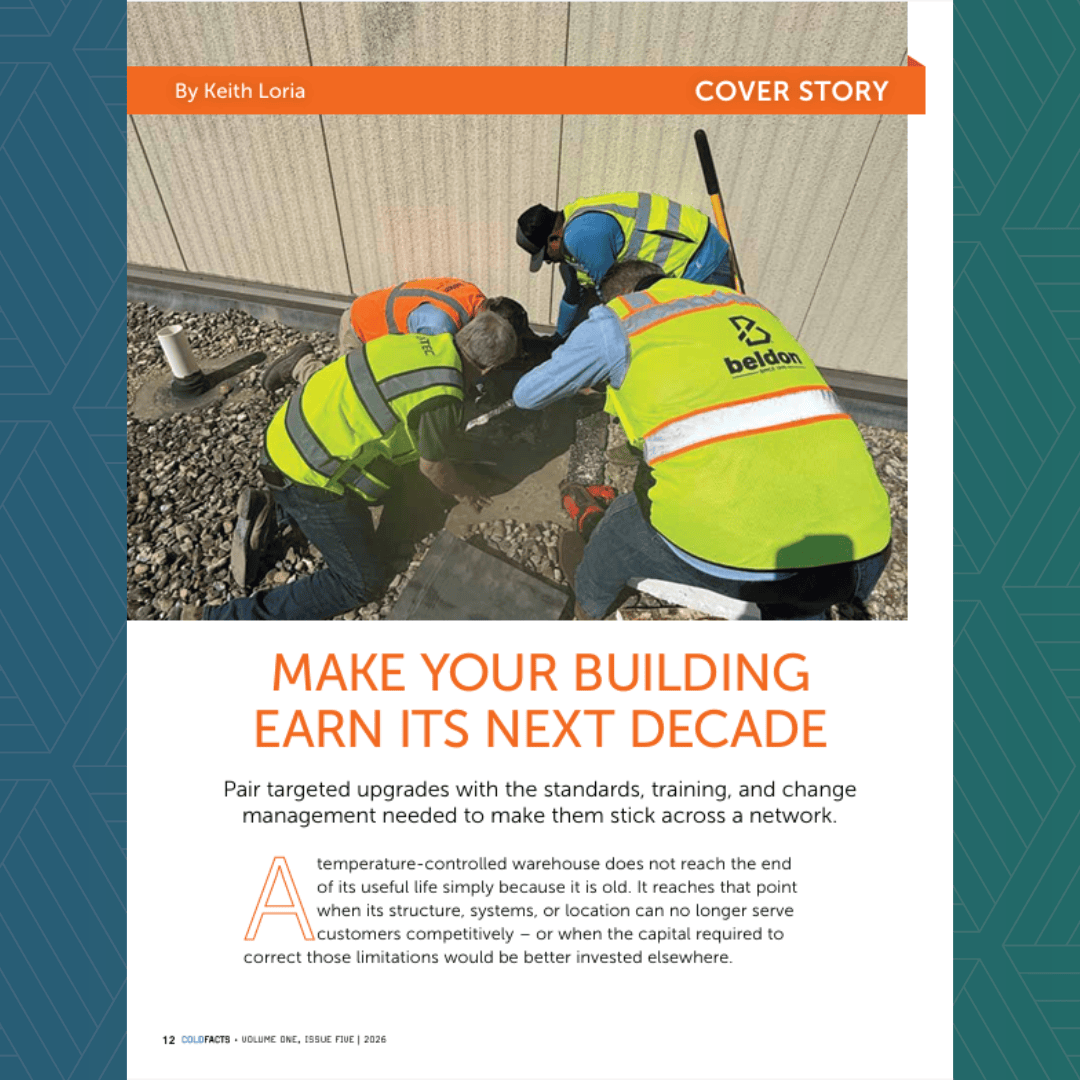
Pair targeted upgrades with the standards, training, and change management needed to make them stick across a network.
 A temperature-controlled warehouse does not reach the end of its useful life simply because it is old. It reaches that point when its structure, systems, or location can no longer serve customers competitively – or when the capital required to correct those limitations would be better invested elsewhere.
That distinction is reshaping the choice between renovating an existing facility, expanding it, or starting over. New refrigeration controls, better envelopes, targeted automation, and real-time operating data can add years of productive life to the right building. Yet capital alone cannot rescue a poorly located asset, overcome an undersized site, or make incompatible technology useful.
The business case comes first. “Age alone really doesn’t determine the facility’s viability or its value,” says Brian Dunn, Senior Vice President of Facilities and Engineering for Americold. “The question is whether the facility can continue delivering long-term value to the customers and the network efficiently.”
When the fundamentals are sound, Dunn says, modernization can extend a facility’s operating life by 15 to 20 years. That prospect makes the upgrade-versus-new-build decision less about a building’s birth date and more about its ability to support the next generation of customer needs.
Start With the Job to Be Done
The first capital decision should be whether the property still has a useful role in the operator’s network. Customer requirements, throughput, reliability, future growth, and the return on invested capital belong in that conversation before a team selects equipment or asks vendors for proposals.
Josh Currie has viewed that decision from several sides: at a design-build company, as a cold-storage operator, and now as President of Thermcon Inc. Each perspective, he notes, reinforces the need to define the owner’s needs and work backward.
“From the operator side, there are operational considerations and the needs of many clients to reconcile,” Currie says. “As an owner of a design-build firm, we try to blend this experience in order to deliver the best result.”
The assessment begins with what customers need, what works today, and what does not. Ownership also matters. A company will evaluate a leased facility differently from an owned asset, especially when an upgrade is tied to an expansion
Michael Lynch, Senior Vice President of Sustainable Engineering at United States Cold Storage, describes the choices as a continuum. USCS has used refrigeration-control replacements, warehouse management system migrations, room conversions, automation, and energy projects to increase capacity, productivity, and reliability inside existing buildings. The company pursues greenfield development when market demand, automation requirements, or site constraints justify it.
That discipline guards against one of modernization’s most common mistakes: selecting technology before defining the problem.
“A lot of folks are just chasing the technology instead of solving the business problem,” Dunn says. “Only after we define the challenge, identify the customer’s need, and agree on the measures of success do we begin determining which improvements make sense.”
That does not rule out experimentation. Currie favors pilots using automated guided vehicles, autonomous mobile robots, or automated storage and retrieval system (AS/RS) modules when they fit the product, volume, and workflow.
These projects can create immediate efficiency while becoming proof cases for future growth. Shared evidence helps executives compare projects across the portfolio and direct scarce capital toward the highestvalue constraint first. It gives capital committees a consistent record of why they made each decision.
Their value still depends on integration. A mechanical system that does not communicate cleanly with the warehouse management system – or that conflicts with established operating methods – can introduce more complexity than it removes.
“Overinvesting or underinvesting often correlates directly with the level of knowledge and understanding of the investment,” Currie said. “A well-planned, highly integrated and expertly executed system can yield great results.”
Interrogate the Bones
Once a building has a continuing business purpose, the investigation turns physical.
A rigorous facility condition assessment should cover traffic flow and site access; the foundation, slab and structure; clear height; the insulated envelope; roof and dock doors; refrigeration and electrical capacity; and lifesafety systems. The team also needs a current description of operations, reliable operating data, and a three- to five-year growth forecast.
The proposed use determines which defects are manageable. Additional electrical or refrigeration capacity can often be installed in an existing building. Limited land and low clear height are harder to solve when the business requires high-volume storage. A roof leak can be repaired; a slab that cannot support a high-density automated storage and retrieval system may change the entire project.
“Can the floor handle it if the data shows an AS/RS system makes the most sense?” asks Stephen Wilson, Director of National Sales for Apex Companies. “Slab thickness and condition can be overlooked in the initial bid process and then become an expensive change order, or an entirely new project, just to get the automation job off the ground.”
Roof quality matters for the same reason. Correct water intrusion above sensors, controls, and automated machinery before commissioning.
Wilson says the combination of a damaged floor, thin slab, deteriorated roof, and insufficient clear height can make relocation or a newer building the more rational answer.
Refrigeration requires an equally unsentimental review. Douglas Reindl, a Professor of Mechanical Engineering and Director of the Industrial Refrigeration Consortium at the University of Wisconsin–Madison, says mechanical integrity and changes in function are the two principal triggers. Equipment designed for a holding freezer, for example, may not be appropriate when that space becomes a contract blast freezer.
Replacement also creates an opening to reconsider size, materials, maintainability, and layout rather than installing a clone of the original. An expansion may leave a once-peripheral machinery room in the center of the operation, creating an opportunity to recover warehouse space and build a machinery room where equipment can be operated, inspected, and maintained safely.
Good maintenance can complicate assumptions about age. Reindl has seen old systems with decades of useful life remaining because the refrigeration staff cared for them meticulously. He’s also witnessed newer equipment run into the ground. Legacy controls and discontinued components can force an upgrade even when the mechanical system is still viable.
Older plants also tend to lack the sensors needed to separate aging equipment from a controls, maintenance, or building problem, Reindl points out.
Count More Than Kilowatts
Modernization proposals are often presented through energy savings, but the most valuable projects solve several problems at once. Operators should consider initial cost, asset condition, reliability, customer service, labor productivity, capacity, safety, and risk reduction alongside energy intensity and maintenance expense.
“One will virtually never justify replacing an existing system with the expectation that the capital cost will be covered in a reasonable time through energy savings,” Reindl says. “Energy here is still too cheap.”
Smaller measures can deliver attractive paybacks. Adjusting set points may require no capital, while variable-frequency drives on evaporator or condenser fans can reduce energy use at modest cost. Reindl recommends that multi-facility companies benchmark comparable sites using a normalized measure such as energy cost per cubic foot per year. Outliers can reveal lowcost opportunities and expose locations where an apparent equipment problem is really an operating problem.
The economics change when reliability, safety, or refrigerant availability enter the equation. An obsolete control platform, unsupported equipment, or a phased-out refrigerant can create a breakpoint at which continued repair becomes the expensive choice. Reduced downtime, improved safety, and the ability to maintain a system with fewer scarce technical resources may support deeper investment even when the energy-only payback does not.
Building-envelope improvements can also produce layered returns. Wilson frequently sees substantial energy opportunities in roofs and dock doors. Currie noted that a failing envelope can hurt working conditions, refrigeration performance and energy consumption at the same time. Another facility may gain more by repurposing space and redesigning product flow.
Americold uses what Dunn calls “a totalvalue lens.” The company examines energy intensity per square foot, but also measures capacity gains, productivity, customer impact, and risk. Over roughly 18 months, the company upgraded refrigeration controls at 11 sites with AI-enabled systems. LED lighting, meanwhile, can lower energy use while improving visibility and picking accuracy. Real-time monitoring across most of the company’s global network gives managers a shared view of performance and helps validate whether an investment delivers the promised result.
Compliance spending can also become a useful modernization window. A required project may offer little direct return on its own, but bundling it with controls, automation, or infrastructure work can create operating value and avoid reopening the same area later. Wilson advises choosing equipment, software, and infrastructure that can adapt as regulations evolve, rather than locking the facility into a rigid solution to today’s requirement.
Modernize Without Losing Your Cool
The best design on paper can fail if its construction plan disrupts temperature control, food safety, employee safety, or customer service. Retrofit teams must map rigid and flexible parts of the operation, shutdown windows, construction sequence, seasonal volume swings, and temporary requirements for cooling, power, and fuel.
Product may have to move to another room, another building, or refrigerated trailers at the dock. Those moves belong in the project budget. So does the premium for multiple mobilizations when installers must return for each phase.
“Exclusively prioritizing the minimization of operational impacts can result in far less efficient construction methods and longer completion timelines,” Currie said. “If that balance is not clearly understood and planned, there can be risks to temperature control, food safety, and employee welfare.”
Americold manages large improvements through a project-governance framework grounded in Project Management Institute practices. Scope, schedule, milestones, project-performance indicators, risks, and mitigation plans remain visible throughout the work. Dunn said those controls protect safety and uninterrupted customer service rather than treating them as assumptions.
The lesson is practical: phasing is an operating model, not merely a construction schedule. Operations, engineering, maintenance, safety, and customer teams must agree on how the facility will work during every stage, not just how it should perform when the ribbon is cut.
Standardize Before Automating
Commissioning is the midpoint of modernization, not the finish. New tools change work, and the value disappears when employees revert to the familiar process or when each site invents its own version of the system.
“Successful adoption of any new technology or automation first requires some standardization,” Dunn said. “You have to have standardization before you have digitization and automation.”
Americold’s answer is its operating system that establishes common processes and aligns key performance indicators, training, and governance across more than 230 facilities in more than a dozen countries. The portfolio includes conventional warehouses, plantattached operations, and highly automated facilities, each with a different workforce, culture, and operating history. A common framework gives the company a baseline without pretending those differences do not exist.
For example, Dunn says the company used early equipment management while installing an AI-enabled optical grader and sorter for fruit. Operations, maintenance, engineering, safety, human resources, and finance participated from concept and design through procurement, installation, and commissioning. Frontline equipment operators learned cleaning and inspection before the machine went live, including where fruit wax or juice could contaminate photo eyes and sensors. Then the equipment operators helped establish cleaning, inspection, and lubrication standards and trained other operators.
That early involvement makes maintainability and reliability design criteria rather than post-installation complaints. It also creates local ownership of the new process.
USCS reinforces adoption through common platforms, formal lessons-learned reviews, and enterprise standards for controls, communications, safety, and integration. Lynch says the company measures training progress, user adoption, and operating results so a successful deployment means more than installing software or equipment. Institutional knowledge matters as well: experienced leaders remember which earlier projects succeeded, which failed, and why.
Portfolio consistency still needs disciplined exceptions. Currie recommends standards for controls architecture, equipment preferences, temperature monitoring, maintenance, safety, training, documentation, and KPIs. Those choices make employees more transferable, simplify maintenance, strengthen purchasing leverage, and improve management visibility. Climate, building age, product mix, customer requirements, and refrigeration design may nevertheless require a different answer at a particular site.
“The goal is to establish a common operating standard and then document justified, site-specific deviations from that standard,” Currie says. “That creates consistency without forcing a solution onto a facility where it does not make operational or economic sense.”
Together, those practices turn modernization from a capital event into an asset-management discipline. The end-user company defines the customer problem and investment thesis; the project team tests the building and systems; and the people who operate and maintain the equipment help shape the work before startup. Common data and standards then make lessons portable across the network.
“The future of cold storage is not simply about building more facilities,” Dunn says. “It is about extracting greater value from existing assets through strategic capital, reliability focused maintenance, targeted automation, and disciplined change management – not chasing technology for technology’s sake.”
***
Contact Us
COLD FACTS Magazine and media inquiries: Lindsay Shelton-Gross, Senior Vice President, Global Communications, Marketing and Strategic Initiatives, Global Cold Chain Alliance
Editorial Ideas: Please contact Editor-In-Chief Alexandra Walsh
Advertising Opportunities: Contact Jeff Rhodes, Vice President of Sales, MCI USA Sales