Cold Facts Magazine
Why is Private Equity So Hot on Cold?
 A Q&A with Investor Relations Expert Evan Pondel
For most of its history, the cold storage industry was viewed as a non-institutional property type, but that view is rapidly changing. Private equity (PE) has transformed the cold storage sector from a niche property type into an institutional-grade asset class characterized by massive consolidation and high-tech modernization. As of 2026, the market is dominated by PE-backed giants that control the majority of North American capacity, though new entrants are emerging.
Institutional capital began to gravitate toward the sector beginning in the early 2010s, and that process has accelerated in recent years. Since 2015, cold storage transactions accounted for only 0.4% of total commercial real estate investment activity in dollar terms, according to MetLife Investment Management. Though a small percentage, 0.4% represents nearly $21 billion in investment activity during the period. The share of institutional investors taking part in these sales has increased, particularly over the last five to eight years. Market watchers expect this trend will help push capitalization rates down, and values up, in the cold storage sector.
Other industry trends that investors are watching include the strong demand for cold storage. Farming and food companies are expected to consolidate inventories into larger, more efficient, modern cold storage facilities to improve logistics and meet consumer preferences.
Investors view pharmaceuticals to be a key growth driver in the cold storage industry. An aging U.S. population, combined with new medicines that require refrigeration, means that the growth in demand from pharmaceuticals will be enduring.
Wall Street also expects that consumer acceptance and adoption of e-grocery delivery services will continue to increase over the long term as well, and grocery supply chains will move toward dedicated e-grocery delivery fulfillment centers, including cold storage facilities, in the pursuit of efficiencies.
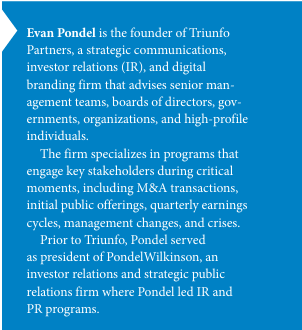
To gain a subject expert’s view of the present and future impact of private equity in the cold storage industry, COLD FACTS interviewed Evan Pondel, the founder of strategic communications, investor relations (IR), and digital branding firm Triunfo Partners.
CF: Given the unique characteristics of the cold chain, how does temperature-controlled storage compare to investing in other assets? Is the industry good for private equity investment, and what are the dynamics that make this sector attractive?
EP: I’d say temperature-controlled storage blends real estate stability with industrial operating complexity, offering inflation linked pricing, high barriers to entry, and sticky, long-term customer relationships that make it more defensible than generic warehousing. Private equity finds temperature-controlled storage attractive for these reasons, though the energy intensity, specialized labor, and capex (capital expenditure) cycles create operational drag that distinguishes it from passive real estate plays.
CF: There are differences between capital structures, return profiles, and operational complexities in legacy (“old”) facilities, versus next-generation (“new”) infrastructure. What are the pros and cons of investing private equity in a traditional vs. new facility, and under what market conditions does old vs. new generate the best return?
EP: The honest answer is it depends on where we are in the cycle. Old assets are great when capital is tight and replacement costs are elevated. You’re buying the moat at a discount, and the cash flow is there day one.
CF: How have investments evolved over the past decade, particularly with post pandemic supply chain disruptions, the rise of pharmaceutical and biologics cold demand, and the wave of consolidation?
EP: A decade ago, this was largely a family owned, under-the-radar industry and then COVID happened and everyone suddenly realized cold chain was critical infrastructure. That, combined with the explosion in biologics and mRNA therapeutics, brought serious institutional capital to the table and kicked off a wave of consolidation that’s still playing out today.
CF: What are the drivers that are leading the cold storage sector to experience high-value acquisitions?
EP: A few things are converging at once: e-commerce grocery, tighter food safety regulations, and the automation premium in modern facilities have all repriced what cold storage is worth. And because there simply aren’t enough well-located, code-compliant assets out there, when something comes to market, buyers are paying for future optionality as much as today’s income.
CF: How do you grow from family-owned regional operators into larger, more efficient, and geographically diverse networks?
EP: The playbook is pretty straightforward, conceptually. You need to find a solid regional operator, use it as your platform, and then bolt on adjacent geographies and services over time until you’ve built something no single-site operator can compete with. The integration work is the hard part.
CF: As infrastructure funds — with their lower cost of capital, longer hold periods, and stable cash flows — increasingly compete for cold storage assets alongside private equity, how do their long investment horizons align with refrigerated facilities?
EP: What’s really interesting here is how cleanly the two models hand off to each other. PE comes in, adds value operationally, and then infrastructure funds, with their longer horizons and lower cost of capital, are natural buyers because cold storage looks a lot like a utility to them: predictable cash flows, inflation linkage, high replacement cost moat.
CF: How are investors delivering, without sacrificing operational efficiency or sustainability targets, and what are some other specific investment barriers to rapid expansion?
EP: Smart folks are pairing development with a real sustainability story, not just to check an ESG box, but because the operating cost savings over time actually justify the premium you pay upfront to build it right.
Market Consolidation & Major Players
The cold storage industry has seen aggressive “roll-up” strategies where private equity (PE) firms acquire numerous smaller competitors to build global platforms.
- Lineage (Formerly Lineage Logistics): Originally PE-owned and grown from a single warehouse in 2008 to over 400 locations today. It recently pursued a massive IPO with valuations exceeding $30 billion.
- Americold: The second-largest player, controlling a combined 71% of North American rentable space with Lineage. In late 2025, it attracted interest from PE-backed firms like Constellation Cold (backed by EQT) and CubeCold (backed by I Squared) for its international operations.
- Cold-Link Logistics: In December 2025, Slate Asset Management and Hamilton Lane acquired a majority stake in this top-10 North American platform.
Emerging Trends & Risks
- Automation & Tech: PE firms are increasingly investing in “OpCo/ PropCo” (operating company/property company) structures to capture value from both the real estate and high margin services like blast freezing and AI-driven predictive maintenance.
- Rise in Vacancy: While historically tight (~3-4%), national cold storage vacancy has risen to roughly 5.3% as of 2025 due to a wave of new speculative construction.
- Higher Entry Barriers: Building cold storage can cost four times as much as traditional warehousing ($150-$200+ per sq. ft.), often requiring specialized lenders and deep-pocketed institutional partners.
- Diversifying Capital: What was once primarily a PE-funded industry now sees heavy involvement from infrastructure funds, sovereign wealth funds, and family offices seeking long duration, stable yields.
Contact Us
COLD FACTS Magazine and media inquiries: Lindsay Shelton-Gross, Senior Vice President, Global Communications, Marketing and Strategic Initiatives, Global Cold Chain Alliance
Editorial Ideas: Please contact Editor-In-Chief Alexandra Walsh
Advertising Opportunities: Contact Jeff Rhodes, Vice President of Sales, MCI USA Sales