Cold Facts Magazine
Next Chapter for CUSMA
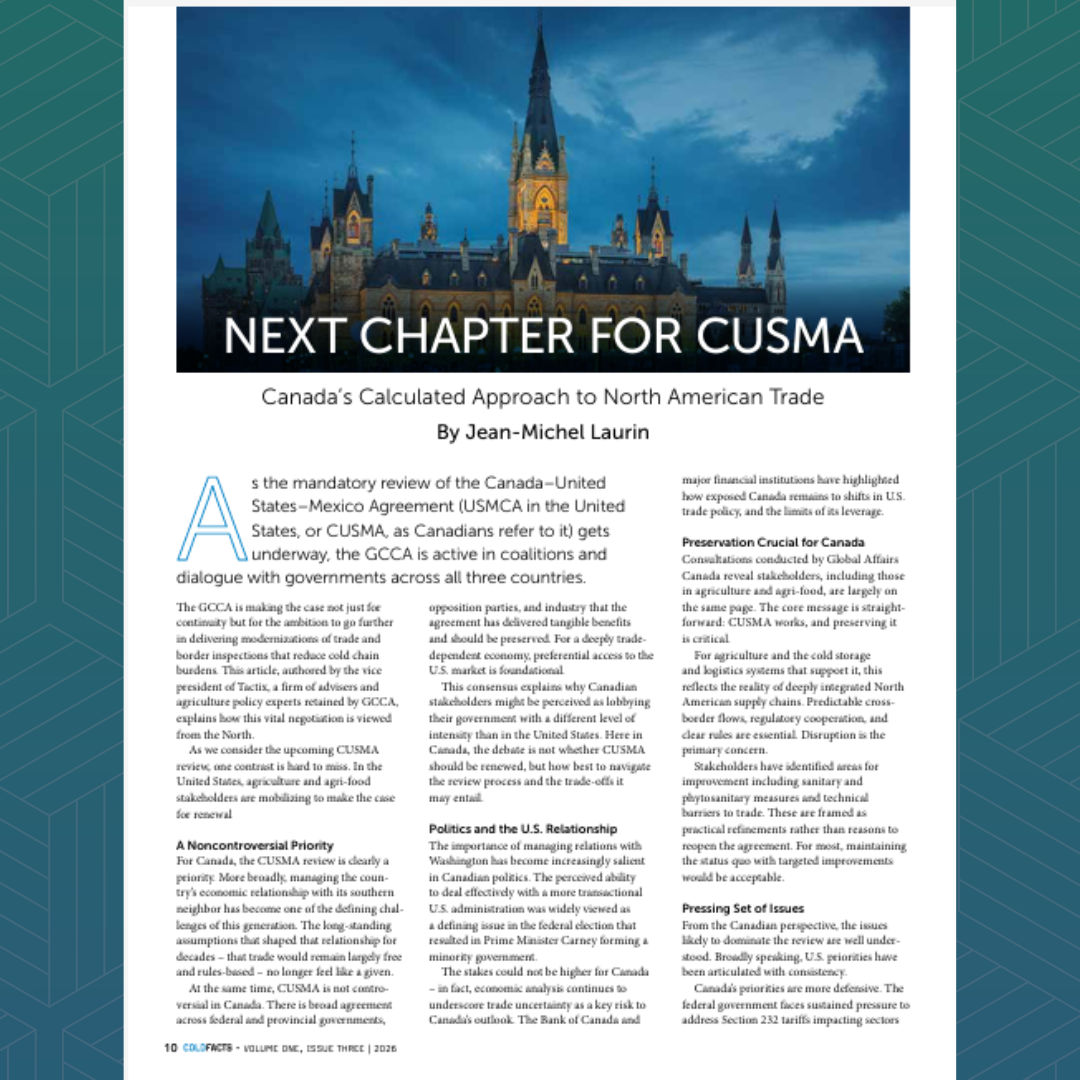
Canada’s Calculated Approach to North American Trade
As the mandatory review of the Canada–United States–Mexico Agreement (USMCA in the United States, or CUSMA, as Canadians refer to it) gets underway, the GCCA is active in coalitions and dialogue with governments across all three countries.
The GCCA is making the case not just for continuity but for the ambition to go further in delivering modernizations of trade and border inspections that reduce cold chain burdens. This article, authored by the vice president of Tactix, a firm of advisers and agriculture policy experts retained by GCCA, explains how this vital negotiation is viewed from the North.
As we consider the upcoming CUSMA review, one contrast is hard to miss. In the United States, agriculture and agri-food stakeholders are mobilizing to make the case for renewal.
A Noncontroversial Priority
For Canada, the CUSMA review is clearly a priority. More broadly, managing the country’s economic relationship with its southern neighbor has become one of the defining challenges of this generation. The long-standing assumptions that shaped that relationship for decades – that trade would remain largely free and rules-based – no longer feel like a given.
t the same time, CUSMA is not controversial in Canada. There is broad agreement across federal and provincial governments, 10 • VOLUME ONE, ISSUE THREE | 2026 opposition parties, and industry that the agreement has delivered tangible benefits and should be preserved. For a deeply tradedependent economy, preferential access to the U.S. market is foundational.
t the same time, CUSMA is not controversial in Canada. There is broad agreement across federal and provincial governments, 10 • VOLUME ONE, ISSUE THREE | 2026 opposition parties, and industry that the agreement has delivered tangible benefits and should be preserved. For a deeply tradedependent economy, preferential access to the U.S. market is foundational.
Politics and the U.S. Relationship
The importance of managing relations with Washington has become increasingly salient in Canadian politics. The perceived ability to deal effectively with a more transactional U.S. administration was widely viewed as a defining issue in the federal election that resulted in Prime Minister Carney forming a minority government.
he stakes could not be higher for Canada – in fact, economic analysis continues to underscore trade uncertainty as a key risk to Canada’s outlook. The Bank of Canada and major financial institutions have highlighted how exposed Canada remains to shifts in U.S. trade policy, and the limits of its leverage.
Preservation Crucial for Canada
Consultations conducted by Global Affairs Canada reveal stakeholders, including those in agriculture and agri-food, are largely on the same page. The core message is straightforward: CUSMA works, and preserving it is critical.
For agriculture and the cold storage and logistics systems that support it, this reflects the reality of deeply integrated North American supply chains. Predictable cross border flows, regulatory cooperation, and clear rules are essential. Disruption is the primary concern.
Stakeholders have identified areas for improvement including sanitary and phytosanitary measures and technical barriers to trade. These are framed as practical refinements rather than reasons to reopen the agreement. For most, maintaining the status quo with targeted improvements would be acceptable.
Pressing Set of Issues
From the Canadian perspective, the issues likely to dominate the review are well understood. Broadly speaking, U.S. priorities have been articulated with consistency.
Canada’s priorities are more defensive. The federal government faces sustained pressure to address Section 232 tariffs impacting sectors such as steel, aluminum, autos, and lumber. These measures have become emblematic of the uncertainty facing exporters. In addition, Canadians feel their government already made concessions, including abandoning its digital services tax. The expectation is that any further concessions would be matched by tangible outcomes.
These measures have come to symbolize the uncertainty exporters are facing. The message is clear: if there are more concessions to come, they better be worth something. There is a shared understanding that flexibility may be required to secure a longer-term extension of CUSMA. That flexibility, however, is conditional. From a Canadian standpoint, extending the agreement now matters less than whether it can meaningfully provide certainty and reduce the risk of disruption.
Certainty Sought but Not Assumed
Canadian stakeholders place a high value on certainty. At the same time, there is growing realism that even a successful review may not restore the predictability once associated with North American trade.
Recent U.S. trade actions have reinforced the limits of formal agreements. Canadian officials have begun signaling that maintaining access to the U.S. market may increasingly come with a baseline cost, potentially in the form of enduring tariffs. The July 2026 review milestone itself may slip, and continuing under the existing agreement – with annual reviews over the next 10 years – has been framed as a viable outcome if a better deal does not materialize.
Canada has navigated similar dynamics before. Strategic patience and disciplined engagement proved effective during the original CUSMA negotiations, and many see value in applying that approach again.
Quiet Not Passive
Canada being perceived as quiet on CUSMA review should not be misread. Stakeholders are engaged, aligned, and actively shaping the government’s approach. The difference is that the debate in Canada is not about whether to renew the agreement, but rather how to navigate a more uncertain and transactional trade environment.
For the cold chain industry, the takeaway is clear: the framework underpinning North American trade remains intact (for now), but the conditions around it are changing. Managing that uncertainty will be as important as the outcome of the review itself.
***
Contact Us
COLD FACTS Magazine and media inquiries: Lindsay Shelton-Gross, Senior Vice President, Global Communications, Marketing and Strategic Initiatives, Global Cold Chain Alliance
Editorial Ideas: Please contact Editor-In-Chief Alexandra Walsh
Advertising Opportunities: Contact Jeff Rhodes, Vice President of Sales, MCI USA Sales