Cold Facts Magazine
Cold Cargo Takes Flight
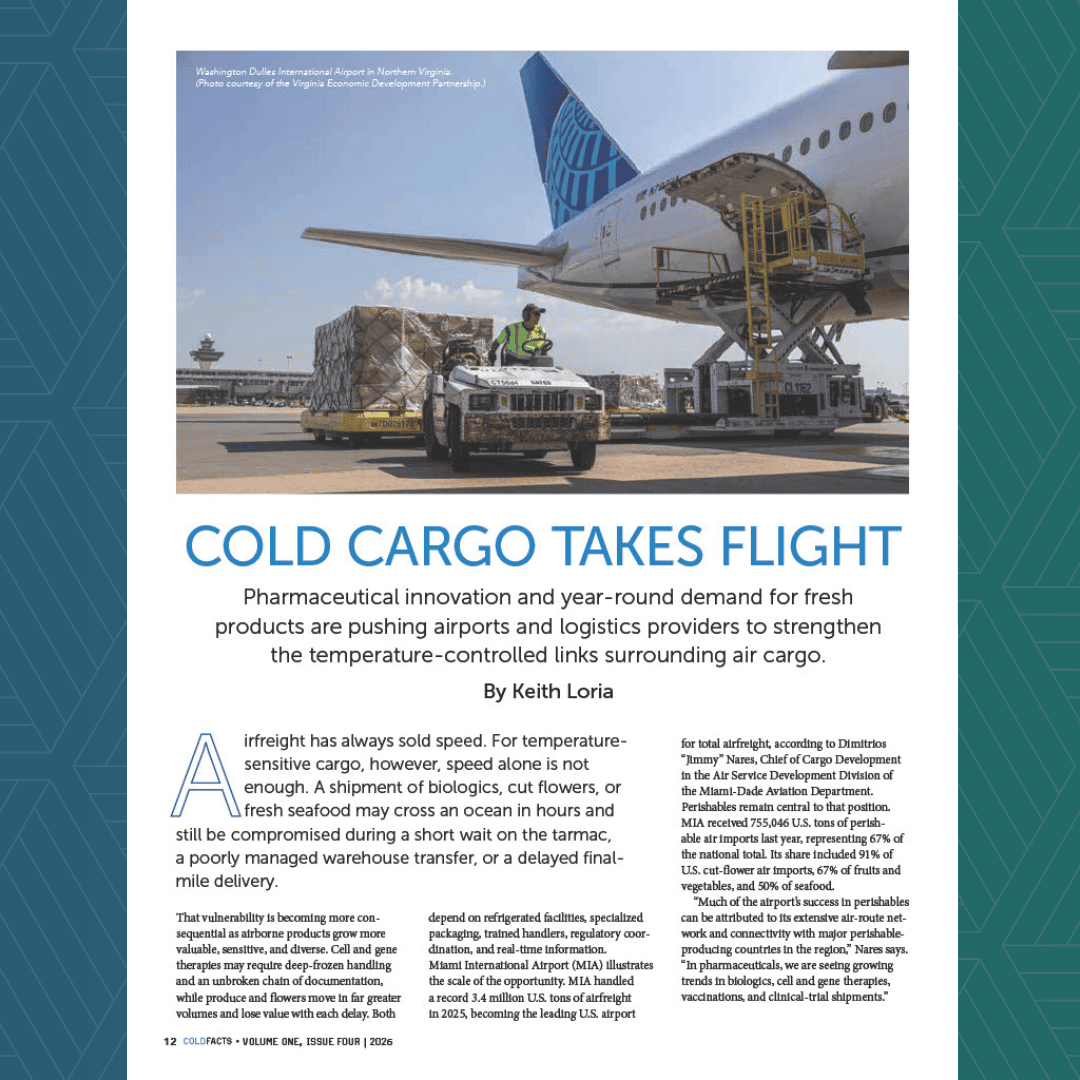
Pharmaceutical innovation and year-round demand for fresh products are pushing airports and logistics providers to strengthen the temperature-controlled links surrounding air cargo.
Airfreight has always sold speed. For temperature sensitive cargo, however, speed alone is not enough. A shipment of biologics, cut flowers, or fresh seafood may cross an ocean in hours and still be compromised during a short wait on the tarmac, a poorly managed warehouse transfer, or a delayed final mile delivery.
That vulnerability is becoming more consequential as airborne products grow more valuable, sensitive, and diverse. Cell and gene therapies may require deep-frozen handling and an unbroken chain of documentation, while produce and flowers move in far greater volumes and lose value with each delay. Both depend on refrigerated facilities, specialized packaging, trained handlers, regulatory coordination, and real-time information. Miami International Airport (MIA) illustrates the scale of the opportunity. MIA handled a record 3.4 million U.S. tons of airfreight in 2025, becoming the leading U.S. airport for total airfreight, according to Dimitrios “Jimmy” Nares, Chief of Cargo Development in the Air Service Development Division of the Miami-Dade Aviation Department. Perishables remain central to that position. MIA received 755,046 U.S. tons of perishable air imports last year, representing 67% of the national total. Its share included 91% of U.S. cut-flower air imports, 67% of fruits and vegetables, and 50% of seafood.
“Much of the airport’s success in perishables can be attributed to its extensive air-route network and connectivity with major perishable producing countries in the region,” Nares says. “In pharmaceuticals, we are seeing growing trends in biologics, cell and gene therapies, vaccinations, and clinical-trial shipments.”
Pharma Raises the Stakes
Life sciences are driving some of airfreight’s most demanding growth. Lorant Kovacs, Vice President of Global Strategy and Sales for the Life Sciences Division at AIT Worldwide Logistics, says demand changes, geopolitical uncertainty, and greater cost consciousness are altering transportation decisions.
The pharmaceutical patent cliff expected through 2030 is contributing to the shift as manufacturers race to introduce generics and biosimilars. Companies are also scrutinizing when a product truly requires air transport. Less urgent freight may move by ocean to lower costs and emissions, while high-value, time-critical products continue to favor air.
Packaging decisions are becoming more selective as well.
“For products that have strong stability data, we are seeing a migration toward hybrid or passive packaging, especially for airfreight,” Kovacs says.
At the sensitive end of the spectrum, biologics, specialty pharmaceuticals, peptides and clinical trial materials are expanding requirements for 2 °C to 8°C, deep-frozen and ultra-deep-frozen transportation. Some therapies require temperatures near minus 80°C, extending the challenge beyond the aircraft and into packaging.
“Companies on the packaging side are developing more robust phase-change materials, and we also anticipate increased demand for liquid-nitrogen shippers,” Kovacs says.
Logistics networks must therefore be able to manage dry ice and, in some cases, refill or recharge liquid-nitrogen shipping systems. Every facility and transportation partner must be prepared for the required temperature range.
MIA began building that airport community through its Pharma Hub initiative in 2015, encouraging cargo tenants to earn IATA Center of Excellence for Independent Validators (CEIV) Pharma certification. Its certified community now includes six airlines, three ground handlers, and two freight forwarders.
The cluster reduces the risk that pharmaceutical cargo will encounter an unprepared handler. Since 2019, pharmaceuticals have risen from MIA’s sixth largest export commodity by volume to its third largest, Nares says.
Protecting the Handoffs
An air shipment moves through a relay of truckers, forwarders, warehouses, ground handlers, airlines, and inspection agencies. Every transfer introduces dwell time and potential exposure.
“The handoff points where temperature controlled cargo changes hands are the most vulnerable points,” Kovacs says. “The industry has focused on addressing those points by adding temperature-controlled infrastructure and creating more robust processes to minimize exposure.”
Preconditioned processes and temperature controlled vehicles can protect the first mile, while direct airport-to-airport routings eliminate connections and additional transfers. Even within a well-controlled route, Kovacs identifies tarmac time as a persistent exposure window.
MIA’s physical arrangement helps compress that interval. Freighters carry 86% of its cargo, and aircraft can park directly in front of on airport warehouses. That reduces the distance between an aircraft and more than 500,000 square feet of refrigerated cooler space. Tenants also use gel and ice packs, thermal blankets, and active temperature-controlled containers to protect cargo while it is outside a cooler.
The risk does not end once a shipment leaves airport property. Ariane Mary Kemper, Co-founder and Chief Operating Officer of eGourmet Solutions, says air tends to be the exception in her company’s frozen and refrigerated fulfillment network because ground transportation provides sufficient speed for most orders at a substantially lower cost.
“The airfreight leg itself tends to be the more dependable part of the journey,” Kemper says. “Even in a mixed air-to-ground shipment, the ground segment is usually where temperature-excursion risk concentrates. The handoff points, like dock transfers and last mile delivery, are where monitoring and tight standard operating procedures matter most.”
UPS Healthcare is addressing that exposure through investments in temperature-controlled cross-dock facilities.
“Our investment is designed to help reduce that risk by keeping sensitive products within a controlled environment as they move between air and ground transportation,” says Kiel Harkness, Vice President of UPS Healthcare Strategy. “The facilities streamline transfers, reduce time spent on loading docks or airport ramps, and maintain tighter control over shipments throughout the process.”
Of course, nothing is handled on a one size-fits-all basis. Pharmaceuticals and biologics generally carry the narrowest tolerances and most rigorous documentation requirements, while food and wellness products add allergen-segregation and shelf-life considerations. Temperature, humidity, lot codes, and expiration dates must follow the shipment through every mode and facility.
Visibility Becomes Actionable
Passive loggers traditionally provided information after delivery, when cargo might already be quarantined or lost. Current Internet of Things devices relay conditions while a shipment remains in transit.
“The provider landscape and technology are at a very accessible place, and that helps the pharmaceutical industry and service providers access actionable data more quickly,” Kovacs says. “A quality investigation or product-release decision can begin while the shipment is still moving rather than after a logger is retrieved and downloaded. The technology has an important limit. Temperature monitoring does not prevent excursions. Only proper temperature protection and temperature management can mitigate the risk.”
UPS combines real-time monitoring with control-tower capabilities, and predefined contingency plans.
“When it comes to complex healthcare logistics, you have to expect the unexpected,” Harkness says. “What matters is how quickly you identify the situation and how effectively you respond.”
Those capabilities allow teams to reroute shipments, adjust transportation plans, or intervene proactively when high-priority healthcare cargo is threatened.
Kemper sees predictive tools adding another layer by helping operators prepare shipments for the conditions they are likely to encounter. Weather and route modeling can inform insulation and refrigerant levels instead of forcing every order into a worst-case packaging configuration. When disruption occurs, real-time information gives operators an opportunity to reroute a shipment, hold an order, or alert a customer before the product is compromised.
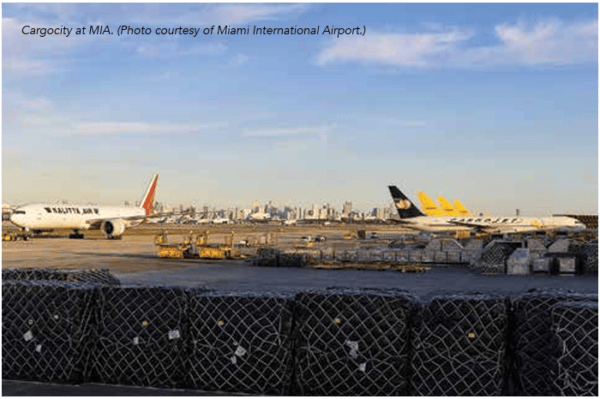
Photo courtesy of Miami International Airport
Airports are also looking beyond shipment level sensors. MIA is working toward an Airport Cargo Community System that would provide logistics partners with real-time cargo information. Nares says the system is intended to improve truck queuing, reduce dwell time, coordinate schedules, and connect systems across the airport cargo community.
Capacity in the Right Place
Expanding temperature-controlled aviation logistics requires more than adding refrigerated square footage. Operators must determine which temperature ranges, commodities, and locations can support an investment – a question Virginia is confronting as it works to develop Washington Dulles International Airport into a larger cargo gateway.
Eric Jehu, Vice President of Transportation and Logistics at the Virginia Economic Development Partnership (VEDP), notes the state’s broader cold chain study extends beyond Dulles. At the airport, however, temperature controlled handling is integral to serving Virginia’s growing pharmaceutical manufacturing base and food and beverage sector.
Major investments announced by pharmaceutical companies Eli Lilly, AstraZeneca, and Merck are expected to place additional demand on the region’s infrastructure as production comes online.
“The demand that temperature-controlled pharmaceuticals will place on the existing infrastructure is greater than what the existing infrastructure can support,” Jehu says.
His proposed sequence begins with high value pharmaceuticals, expands into premium perishables, and eventually develops the larger ecosystem needed for high-volume produce.
Building in that order matters because mass-market perishables require more infrastructure and more participants while producing lower yields.
“The hardest question to answer is exactly what to build where, and maybe even more importantly, when,” Jehu says.
Some parts of Virginia already have excess frozen capacity, while facilities serving different temperatures or agricultural production areas could fill quickly. Aging cold-storage assets may also be positioned far from where demand has migrated.
Dulles already has cargo from Virginia and neighboring states trucked to New York, Newark, or Chicago because local infrastructure is constrained. The airport offers something those mature gateways largely lack developable land inside the fence. Its wide-body passenger network is another asset because more than half of global air cargo travels in passenger-aircraft belly space, Jehu notes.
VEDP has signed a memorandum of understanding with Brussels Airport Company, Air Cargo Belgium, and United Airlines to promote a Brussels-Dulles pharmaceutical corridor. The next step is attracting airport investment from an existing operator or new tenant, including temperature-controlled capabilities.
MIA, meanwhile, is adding capacity within a mature and heavily utilized gateway. A planned phytosanitary treatment and cold-chain processing facility adjacent to the airfield will add 200,000 square feet of cold storage and 50,000 square feet for irradiation. The chemical-free treatment could accommodate products such as proteins and pet snacks that cannot use traditional gas fumigation and may extend the shelf life of some perishables.
Resilience Takes Flight
Geopolitical conflict, scarce capacity, extreme weather, and cost pressure are making contingency planning a core cold chain capability. A preferred airline, package, or route may work under normal conditions but leave a shipper exposed when a lane closes or capacity tightens.
“In today’s world, a simple supply chain design is definitely not enough,” Kovacs says. “When markets are tight and capacity is scarce, having secondary options – whether that is packaging, a different mode of transportation, or a different way to reach the market – is crucial.”
That optionality ties together the industry’s major investments. Airports need cooler capacity and efficient inspection processes but also connected cargo communities. Logistics providers need real-time data but also packaging and procedures capable of preventing the excursion an alert detects. Shippers need airfreight speed but also protected first- and last-mile connections.
As pharmaceutical innovation raises the value and sensitivity of airborne cargo and consumers expect uninterrupted access to fresh products from around the world, the air cargo cold chain will continue expanding. Its success will be measured not simply by how quickly an aircraft crosses the sky, but by how reliably every participant protects the product before takeoff, through each handoff, and all the way to its destination.
***
Contact Us
COLD FACTS Magazine and media inquiries: Lindsay Shelton-Gross, Senior Vice President, Global Communications, Marketing and Strategic Initiatives, Global Cold Chain Alliance
Editorial Ideas: Please contact Editor-In-Chief Alexandra Walsh
Advertising Opportunities: Contact Jeff Rhodes, Vice President of Sales, MCI USA Sales