Cold Facts Magazine
The Long Shadow of the Hormuz Disruption
A post-conflict geopolitical risk analysis.
 When Chinese political pressure made Hong Kong untenable for global institutions, Singapore absorbed the exodus. Banks moved their regional headquarters south; fund managers followed.
A decade of accumulated trust in one hub transferred to another, almost within a single business cycle, because the underlying demand for a stable Asian financial base never disappeared – it just needed a new address. Though the trigger is different, the Gulf Cooperation Council (GCC) now presents a structurally similar question and challenge.
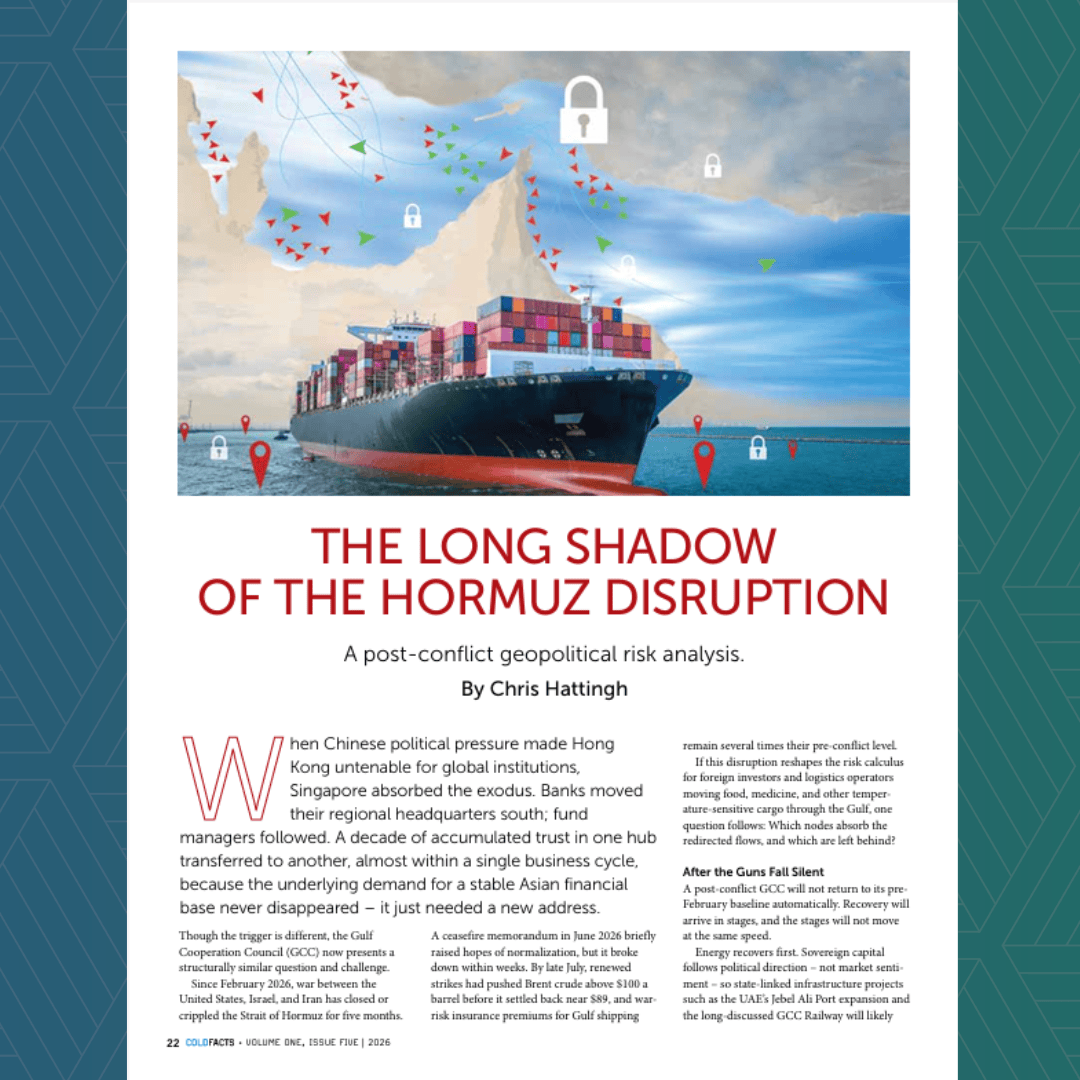
Since February 2026, war between the United States, Israel, and Iran has closed or crippled the Strait of Hormuz for five months. A ceasefire memorandum in June 2026 briefly raised hopes of normalization, but it broke down within weeks. By late July, renewed strikes had pushed Brent crude above $100 a barrel before it settled back near $89, and warrisk insurance premiums for Gulf shipping remain several times their pre-conflict level.
If this disruption reshapes the risk calculus for foreign investors and logistics operators moving food, medicine, and other temperature-sensitive cargo through the Gulf, one question follows: Which nodes absorb the redirected flows, and which are left behind?
After the Guns Fall Silent
A post-conflict GCC will not return to its preFebruary baseline automatically. Recovery will arrive in stages, and the stages will not move at the same speed.
Energy recovers first. Sovereign capital follows political direction – not market sentiment – so state-linked infrastructure projects such as the UAE’s Jebel Ali Port expansion and the long-discussed GCC Railway will likely resume on schedule once a durable ceasefire holds. Governments have both the balance sheets and the political will to keep national strategies moving regardless of near-term risk.
Private capital moves more slowly. Cold chain investment depends on multi-year lease and financing decisions made by companies answering to shareholders. Those shareholders will want to see months, not weeks, of stable transit through Hormuz before committing new capital to warehouses, reefer fleets, or long-haul contracts. The months of disruption already logged in 2026, on top of a broken ceasefire, will likely extend that observation period well past the point a formal peace agreement is signed.
A risk premium will persist even after hostilities end. War-risk insurers who raised premiums fourfold or fivefold during active conflict do not return to baseline pricing the moment strikes stop. They wait for a track record. The Hormuz disruption of 2026 is a live illustration of how quickly confidence in a supply route can collapse and how slowly it rebuilds once the immediate danger passes.
Structural Shift or Temporary Disruption?
The question that matters most for the GCC’s food trade and cold chain infrastructure is whether the appetite for foreign investment snaps back to where it was in January 2026 or recalibrates permanently around a Gulf that carries a standing geopolitical discount.
Financial flows can reverse in a quarter; a trader that avoided Hormuz-adjacent routes in April can resume them in October, if justified by prices and safety data. Infrastructure commitments do not work that way.
A cold storage facility, a reefer fleet, or a port terminal represents a decision with a 10 or 20-year horizon. Once that capital has been redirected to an alternative hub, and the corridor logistics and customer relationships around it have been rebuilt, reversing the decision costs more than the original one did.
This asymmetry is the reason infrastructure tends to lag conventional recovery narratives. It also means that if enough operators redirect capital during a period of sustained risk, the redirection becomes durable even after the original threat has faded, simply because rebuilding the old network costs more than maintaining the new one.
The GCC imports up to 85% of its food, including 90% of its cereals and all of its rice. That level of dependence means any credible alternative route to move perishable and temperature-controlled cargo into the region, or through it, will attract sustained attention regardless of how the conflict resolves. Investors who diversify sourcing and routing during 2026 are unlikely to fully unwind that diversification in 2027, because the cost of insurance and delay they experienced this year will not be forgotten quickly – even if it is not repeated.
Where Does Trade Redirect?
If a structural shift is under way, three types of beneficiary nodes emerge, and they do not all follow the same logic.
South and Southeast Asian cold chain hubs benefit from commercial logic more than political alignment. Singapore, Malaysia’s Port Klang, and India’s western ports already carry established cold storage capacity and shipping frequency. They do not need new political relationships to absorb diverted volume. They need capacity expansion, and several are already building it in response to demand from GCC-linked trade diversification.
East African corridor development follows a mixed logic. Ports in Kenya, Tanzania, and Djibouti sit closer to Gulf markets than Asian alternatives, and Gulf sovereign wealth funds have already invested directly in East African port and agricultural infrastructure. That combination of proximity and existing capital ties makes East Africa a candidate for GCC-direction rather than purely commercial redirection. The corridor benefits when Gulf capital moves to de-risk its supply base, not only when third-party investors choose a new route.
Turkey and Egypt occupy the most politically inflected positions. Both offer land-bridge and Suez-adjacent alternatives to a maritime route through Hormuz, and both have used the conflict to position themselves as reliable players. But their attractiveness depends on continued stability in the Red Sea corridor as well, which has also been disrupted through Houthi activity against Saudi Red Sea ports.
A redirection toward Turkey and Egypt bets on two separate geopolitical variables resolving favorably at once, making it a higher-risk, higher-reward option than the more commercially straightforward Asian alternative.
Distinguishing which redirections are driven by commercial logic and which by political alignment matters. It tells operators which flows will persist regardless of who is in power in the destination country, and which flows depend on relationships that could change with the next election or the next succession.
The New Model
If GCC instability proves durable, the reconfigured global food trade architecture over the next 36 months will not look like a return to the pre-war map with a Gulf-shaped gap filled by a single new hub. It will look more like a diversified network in which no single chokepoint carries the weight Hormuz once did, mirroring what happened globally after the 2021 Suez blockage prompted permanent interest in alternative east-west routes.
The institutional winners will be the ports and cold chain operators that had already begun building multi-temperature capacity and digital traceability systems before the conflict started, because they can absorb new volume immediately rather than waiting years to build it. Gulf-based operators that invested early, such as the cold chain expansions already underway in Riyadh, are positioned to capture a share of the region’s own diversification rather than lose ground entirely to outside hubs.
Logistics operators and investors should watch three signals over the coming months: whether war-risk insurance premiums for Hormuz transit begin a sustained decline rather than a temporary dip during lulls in fighting, whether GCC sovereign wealth funds increase direct stakes in East African or South Asian port infrastructure, and whether private cold chain capital that left the region during 2026 begins returning to Gulf-based facilities or instead commits to long-term leases elsewhere.
The first movements in each of these three indicators will tell the story well before any formal peace agreement does.
***
Contact Us
COLD FACTS Magazine and media inquiries: Lindsay Shelton-Gross, Senior Vice President, Global Communications, Marketing and Strategic Initiatives, Global Cold Chain Alliance
Editorial Ideas: Please contact Editor-In-Chief Alexandra Walsh
Advertising Opportunities: Contact Jeff Rhodes, Vice President of Sales, MCI USA Sales