Cold Facts Magazine
Preparing Now for 2028 Food Traceability Rule
Opportunity for operators to evaluate new tech solutions.
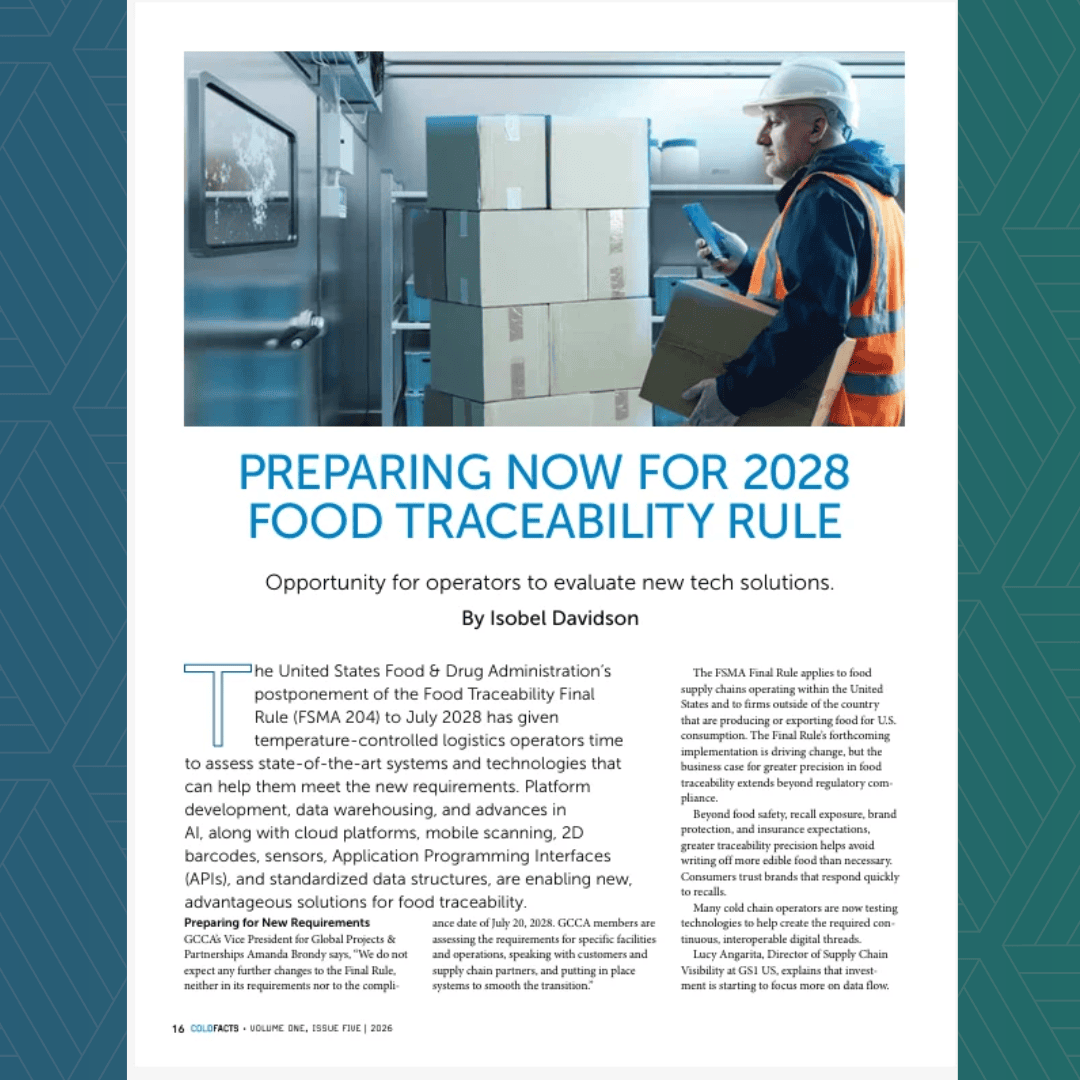
 The United States Food & Drug Administration’s postponement of the Food Traceability Final Rule (FSMA 204) to July 2028 has given temperature-controlled logistics operators time to assess state-of-the-art systems and technologies that can help them meet the new requirements.
Platform development, data warehousing, and advances in AI, along with cloud platforms, mobile scanning, 2D barcodes, sensors, Application Programming Interfaces (APIs), and standardized data structures, are enabling new, advantageous solutions for food traceability.
Preparing for New Requirements
GCCA’s Vice President for Global Projects & Partnerships Amanda Brondy says, “We do not expect any further changes to the Final Rule, neither in its requirements nor to the compance date of July 20, 2028. GCCA members are assessing the requirements for specific facilities and operations, speaking with customers and supply chain partners, and putting in place systems to smooth the transition.”
The FSMA Final Rule applies to food supply chains operating within the United States and to firms outside of the country that are producing or exporting food for U.S. consumption. The Final Rule’s forthcoming implementation is driving change, but the business case for greater precision in food traceability extends beyond regulatory compliance.
Beyond food safety, recall exposure, brand protection, and insurance expectations, greater traceability precision helps avoid writing off more edible food than necessary. Consumers trust brands that respond quickly to recalls.
Many cold chain operators are now testing technologies to help create the required continuous, interoperable digital threads.
Lucy Angarita, Director of Supply Chain Visibility at GS1 US, explains that investment is starting to focus more on data flow. “Organizations are increasingly considering how traceability data moves end to end and where it breaks, leading to investments that can integrate with existing operations instead of becoming another isolated tool.”
Angarita advises priority actions for 3PLs should include mapping data flows, focusing on high-volume partners, validating master data, and conducting mock recalls and Food and Drug Administration (FDA) response drills.
GCCA Update on FSMA
“GCCA continues to engage with the FDA on Final Rule implementation, including through the Partnership for Food Traceability (GCCA represents members in this partnership). We are raising key cold chain concerns, including the lack of standardization for technologies and traceability lot codes, and the lack of protocols for action when the data a 3PL receives is bad or missing. We are impressing upon regulators the differences between the 3PL model and distribution models where product ownership passes on.
“Many GCCA members are progressing in their preparations, businesses not yet underway should reach out to GCCA for help getting started and to connect you to suitable contacts and relevant guidance. GCCA is creating new and updated FSMA resources for members on a regular basis, and there is also useful information on the FDA, GS1, and Partnership for Food Traceability websites.” – GCCA Vice President Global Projects & Partnerships Amanda Brondy
New Role in Food Traceability
The role of cold chain operators in food traceability has changed substantially since the turn of the decade. “Historically, many companies relied on paper records, spreadsheets, disconnected systems, and manual reconciliation to determine what happened to a product after a concern arose,” says Michael Armanious, CEO of Datex, a warehouse management software business. “Traceability has moved from being a retrospective recordkeeping exercise to becoming part of real-time warehouse execution. Temperature-controlled 3PLs now operate as both physical custodians of product and critical custodians of data.”
Chris McGinnis, Principal Solution Advisor, Supply Chain Advisory at Blue Yonder, a digital supply chain transformation business, agrees.
“Operators that ship and receive listed foods now have responsibilities for capturing key data elements from executed critical tracking events,” says McGinnis. “Lot codes, with event history attached, are reorganizing what every system in the chain has to do. The 3PL has changed from supporting a customer’s supply chain to being an extension of their customers’ supply chains, and their technology must match what their customers have.”
Final Rule Challenges
Maintaining the complete and usable chain of information required by the Final Rule brings particular challenges for 3PL cold chain businesses. Temperature data must connect to traceability data that establishes product identity, location, ownership, status, and movement history; and different customers may have different lot structures, requirements, data formats, and expectations.
For foods on the FDA’s Food Traceability List, companies must maintain Key Data Elements associated with applicable Critical Tracking Events and connect those records to the appropriate traceability lot code. Beyond receiving and shipping, additional services can introduce further complexity.
“The operational difficulty appears in the exceptions and value-added processes: repacking, relabeling, kitting, commingling, transformation, cross-docking, inventory holds, owner changes, and transfers between facilities,” Armanious says. “If the physical process changes the product or its traceability relationship, the supporting data must preserve that history.”
The disconnect between solutions for planning, manufacturing, transportation, and warehousing is another major challenge. A single lot’s history could be spread across multiple systems sharing no common data model or format. “The cost lands on operators and supervisors,” McGinnis says, “for whom building an end-to-end view means opening each system in turn, exporting, and reconciling by hand. People who should be running a floor spend their shift stitching spreadsheets together instead.”
Brondy also highlights the difficulties posed by the lack of data standardization. “In the event of a traceback, retrieving records within 24 hours of FDA’s request becomes very difficult if all the records are stored and shared in different formats.”
Today’s Technologies
Cold chain businesses are looking to new and emerging technologies to enable precision traceability alongside other key operational needs such as efficiency, resilience, sustainability, speed, and flexibility to customers’ needs.
For 3PLs serving multiple customers, modern Warehouse Management Systems (WMS) can provide a common operational foundation while allowing customer-specific workflows and controls. Armanious says, “There is a fundamental shift: traceability is no longer a report assembled after the fact. It is an operational record created by the warehouse processes themselves.”
Advances in command centers are unlocking new opportunities too. “Traditional control towers, being reactive by design, could flag a problem but not work out who needed to act on it,” explains McGinnis. “The current generation of command centers detects meaningful change, works out who is affected, recommends a response, and coordinates it across the parties involved.”
Another exciting developing technology in food traceability for McGinnis is the shift from supply chain point solutions to supply chain suites
“Instead of pulling from five systems, supply chain suites leverage a unified underlying data model,” says McGinnis. “One model runs across every stage, so a lot code means the same thing to the planning engine, the warehouse, the transportation planner, and the labor system. Downstream execution will adjust in real time to upstream changes.”
Angarita highlights 2D barcode systems such as the GS1 DataMatrix. Omnidirectional, these tolerate damage and print imperfections through error correction and hold more data in a smaller footprint.
“In a cold, wet, fast-moving environment, error correction isn’t a spec sheet feature. Being able to communicate a traceability lot code from wherever the product was initially packed all the way downstream, without a human typing numbers, is dramatically less error-prone and more efficient.” Angarita also points to EPCIS (Electronic Product Code Information Services), a global GS1 standard that enables trading partners to create and share supply chain visibility event data.
The Next Developments
Exciting emerging technologies are set to advance food traceability still further. For Armanious, the most promising developments are the technologies that reduce the distance between a physical warehouse event and its digital record. “Connected sensors can bring environmental and product-condition data closer to inventory movement records,” he says. “Mobile scanning, 2D barcodes, RFID (radio-frequency identification), and potentially computer vision can reduce manual entry and improve the accuracy and timeliness of lot-level identification.”
Developments also continue in connected packaging, where sensors put on the case, and eventually the item, enable automated reporting of their location and condition. The chain of custody becomes self-reporting rather than reconstructed after the fact. “This has been a standard in high-value pharmaceutical shipping for years,” says McGinnis, “and falling costs are now moving it into the food and grocery vertical.”
A pilot is underway for the GS1 US Rapid Record, helping growers capture information at harvest, cooling, packing, and shipping. Angarita says: “With no app, no new platform or Wi-Fi needed, it saves time recording events and produces an organized, standarized, sortable electronic file for downstream partners to use.”
AI’s maturation is expected to move the needle, too. However, Armanious notes that AI cannot reconstruct an event that was never captured or correct for an unreliable product identity at the source.
“The future of food traceability is not about collecting the most data,” Armanious concludes. “It is about creating reliable, connected, and usable data at every critical operational event. When traceability is built into warehouse execution, operators can protect consumers, respond faster, and avoid unnecessarily disrupting product that was never affected.
***
Contact Us
COLD FACTS Magazine and media inquiries: Lindsay Shelton-Gross, Senior Vice President, Global Communications, Marketing and Strategic Initiatives, Global Cold Chain Alliance
Editorial Ideas: Please contact Editor-In-Chief Alexandra Walsh
Advertising Opportunities: Contact Jeff Rhodes, Vice President of Sales, MCI USA Sales