Cold Facts Magazine
Cold Chain in Central and Eastern Europe
A maturing food supply chain brings vigorous professionalization and consolidation.
Change is afoot in the Central and Eastern European food industry. Food processing is transitioning from local independent specialists to large multinational producers. Distribution is changing from small convenience stores to large multinational retailers.
The consumption balance is shifting from fresh cooking and small local bistros towards frozen convenience meals and large foodservice chains. There is a marked professionalization of food supply chains currently underway, and demand for temperature-controlled logistics is growing more strongly in Eastern Europe than in its Western neighbors.
The region’s cold chain businesses are responding with vigor.
A Changing Food Supply Chain
Food logistics across Central and Eastern Europe now have strong scope for structural evolution, says Casper Roex, Partner at OC&C Strategy Consultants. To date, demand for outsourced third-party cold chain services in the region has been materially less than in Western Europe, where a bigger share of food already travels through the cold chain in its journey from farm to fork. “In Central and Eastern Europe, there has been less large-scale grocery or professional foodservice distribution and less penetration of quick service restaurants,” says Roex “Food processing has been smaller in scale and in earlier stages of professionalization. There has been less propensity to outsource logistics services to 3PLs. As a result, cold chain solutions are smaller in scale, and few businesses operate multiple sites. Now, with the region’s food supply chain starting to mature, we can expect professionalization and consolidation across the cold chain.”
As this process continues, the rate of demand for cold chain is expected to differ by country and product category, but OC&C anticipates growth in the high single digits across the region.
The increasing demand for cold chain is not focused solely on space but also on quality and integration of service. Maciej Kisiel is CEO and Managing Director of Coldstore Gdańsk, which specializes in high-quality handling of frozen food products at Poland’s Port of Gdańsk. Maciej Kisiel says, “We are seeing rising demand for solutions that combine frozen storage with a broader logistics and port service package. Customers increasingly want one reliable partner who can manage the cargo safely from vessel or container to warehouse and then onward into the domestic or regional market. The strongest demand today is for reliable reefer logistics embedded in a port ecosystem because for many customers, speed, predictability, and risk management are now just as important as the cold store itself.”
Poland: Leading the Response
In recent years, Poland has set the pace in the region’s cold chain development. Artur Spala, Operations Director Central & Eastern Europe at NewCold, which operates two sites in the country, says, “Poland is one of the biggest food producers in Europe and a worldwide leader in production of certain food segments such as poultry or pork. Although price pressure is extremely high, there is an increasing demand for high-quality and sustainable logistics solutions. Customers are increasingly interested in co-operation with one logistics provider offering a full spectrum of services in multi-vendor distribution centers like Kutno and Modlin.”
As well as strengthening its role as a domestic food logistics market, Poland has also become a gateway for frozen and chilled cargo moving into Central and Eastern Europe from all directions. There is high value in cold chain operators’ ability to connect storage with maritime logistics, intermodal transport, border procedures, and increasingly complex customer requirements. The industry has become more professional, more infrastructure-dependent, and more tightly linked to wider supply chain resilience.
A key area of growth is the cold chain’s response to investment in Polish ports. A number of cold store developments and expansions are due for completion in the coming year, including the expansion of Coldstore Gdańsk facilities at the Port of Gdańsk, a 45,000-pallet high-bay Cedrob warehouse also at the Port of Gdańsk, and a new 30,000-pallet facility under construction by MSC at Gdynia port. Further west, Paula Fish is constructing a 30,000-pallet temperature-controlled warehouse in Slupsk.
“Investment in Polish ports is strengthening the cold chain in three fundamental ways: throughput capacity, hinterland connectivity, and operational reliability,” Maciej Kisiel says. “ A fourth element that matters greatly is digitalization and system integration. Here, we have a lot still to do.”
NewCold Invests in Romania
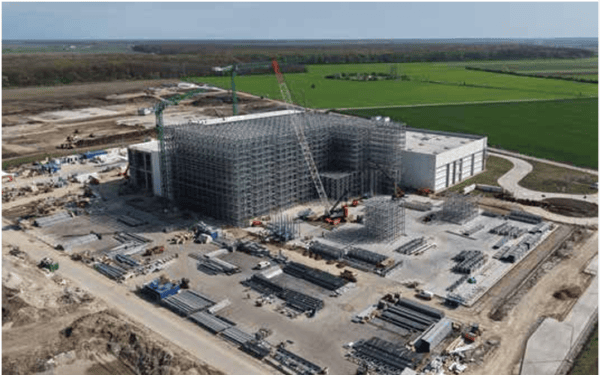
Photo courtesy of NewCold Bucharest.
With Poland leading the way, the food supply chain is changing also in other Central and Eastern European countries. Industry-leading businesses such as Citronex, one of the largest fruit traders in Europe, are expanding their operations beyond Poland into Hungary and Romania.
“Romania is strategically important because of the role of Constanca port and the wider Black Sea logistics environment,” explains Maciej Kisiel. “From a cold chain perspective, Romania is a market with clear growth potential. It has a large domestic food market, an increasingly relevant port gateway, and a growing role in regional trade flows. Romania is moving from being a market of local importance to one of much stronger regional relevance.”
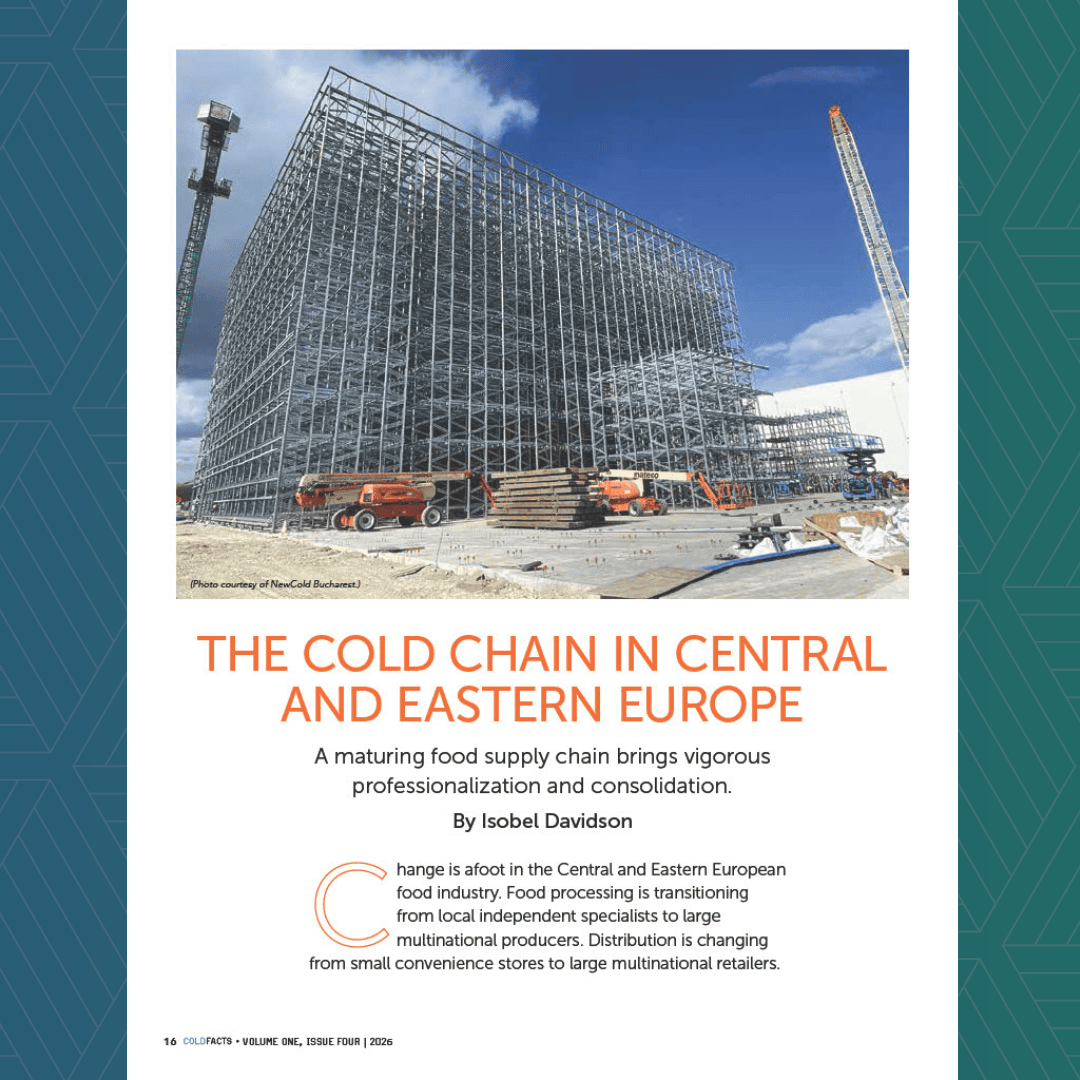
Global cold chain business NewCold is completing a major project in Bucharest to create a new hub for the business network in the region. This 75,000-pallet high-bay site, which will become fully operational at the beginning of 2027, is set to be the most advanced facility in the Balkan region with automated storage, handling in and out, picking and VAS (mixing, labeling, copacking) designed to respond to the needs of NewCold’s current and future customers in Romania. The facility’s throughput will reach 10,000 pallets daily, operating 24/7.
“NewCold is following the needs of our key partners worldwide,” explains Spala. “The development of our site in Romania was due to long-term co-operation with one of the biggest bakeries located in Bucharest. We are also responding to the increased demand for cold chain more widely in the food sector of the Romanian market, as one of the biggest importers of food products in Europe. Romania plays an increasingly important role in the European food supply chain, and our investment here reflects our confidence in the region. Our new project in Bucharest will become the center of vendors’ consolidation and an important part of our end-to-end solution.”
To date, automation has been confined to Central and Eastern Europe due to concentration of demand and relatively low labor costs. But as the market develops, automation is expected to increase, and the NewCold facility in Romania is set to deliver.
Global Investment
With less penetration and more fragmentation than in Western Europe, the potential for international investment in Central and Eastern Europe’s cold chain growth is strong. OC&C expects that investment in the sector will follow a similar pattern to Western Europe.
Roex says, “Investor-backed platforms will likely look increasingly for opportunities in the region, as a way to broaden their scope beyond Western Europe, where consolidation has reached a more mature level, and opportunities are harder to find. Poland and the Czech Republic have already experienced material interest from investors and platforms, as those markets are closer to Western Europe on the maturity curve.”
Outside those nations, the size and modernization of cold storage operators is still limited in comparison to Western Europe. Roex adds, “That provides opportunities for local investors to support the development of such professional at-scale operations that could be attractive targets for investors currently active in Western Europe.”
Impacts of World Events
The global supply chain disruptions associated with war in the Middle East and closure of the Strait of Hormuz have had clear impacts on Central and Eastern Europe. For NewCold’s Spala, the impact has been clearly visible in energy, fuel, and gas prices, impacting the overall costs of warehousing and distribution.
Maciej Kisiel considers that the challenges have underlined the value of cold chain resilience. “Customers need partners who can manage delays, rerouting, changes in transit time, and administrative complexity without compromising temperature integrity or service continuity. Cold chain is no longer just an infrastructure business; it is increasingly a resilience business.”
Temperature-controlled logistics operators in the region are contending with localized challenges, too. Maciej Kisiel is working with a delegation discussing the inefficiencies of inbound procedures for seafood imports with Polish Ministers. He also highlights energy costs and infrastructure imbalance as key challenges in Central and Eastern Europe. “Some parts of the region are developing quickly, especially around ports and major transport corridors, but other areas still lack the road, rail, intermodal or utility infrastructure needed for efficient temperature controlled logistics.”
Looking to the Future
With a higher rate of growth expected than in the more mature Western Europe market, the outlook overall is positive for Central and Eastern Europe. Roex says, “The combination of high demand growth for the cold chain and a fragmented competitive landscape represents a big opportunity in Central and Eastern Europe. For local operators, achieving scale and high professional standards will attract the interest of investors and platforms that have so far primarily focused on Western Europe.”
Maciej Kisiel also sees exciting opportunities for cold chain development in the region. “As well as the growth of Central and Eastern Europe as a logistics gateway, we will see further professionalization of food supply chains and continued growth in frozen and chilled food consumption and trade. There are also significant opportunities in the development of intermodal and regional distribution networks. As the market becomes more integrated, there is a strong opportunity to build cold chain platforms that connect ports, road, rail, and inland markets more efficiently.”
As the professionalization of the region’s food supply chains continues, temperature controlled logistics in Central and Eastern Europe are certainly important to watch.
***
Contact Us
COLD FACTS Magazine and media inquiries: Lindsay Shelton-Gross, Senior Vice President, Global Communications, Marketing and Strategic Initiatives, Global Cold Chain Alliance
Editorial Ideas: Please contact Editor-In-Chief Alexandra Walsh
Advertising Opportunities: Contact Jeff Rhodes, Vice President of Sales, MCI USA Sales