Cold Facts Magazine
The 2026 U.S. Midterms
What they mean for temperature-controlled logistics worldwide.
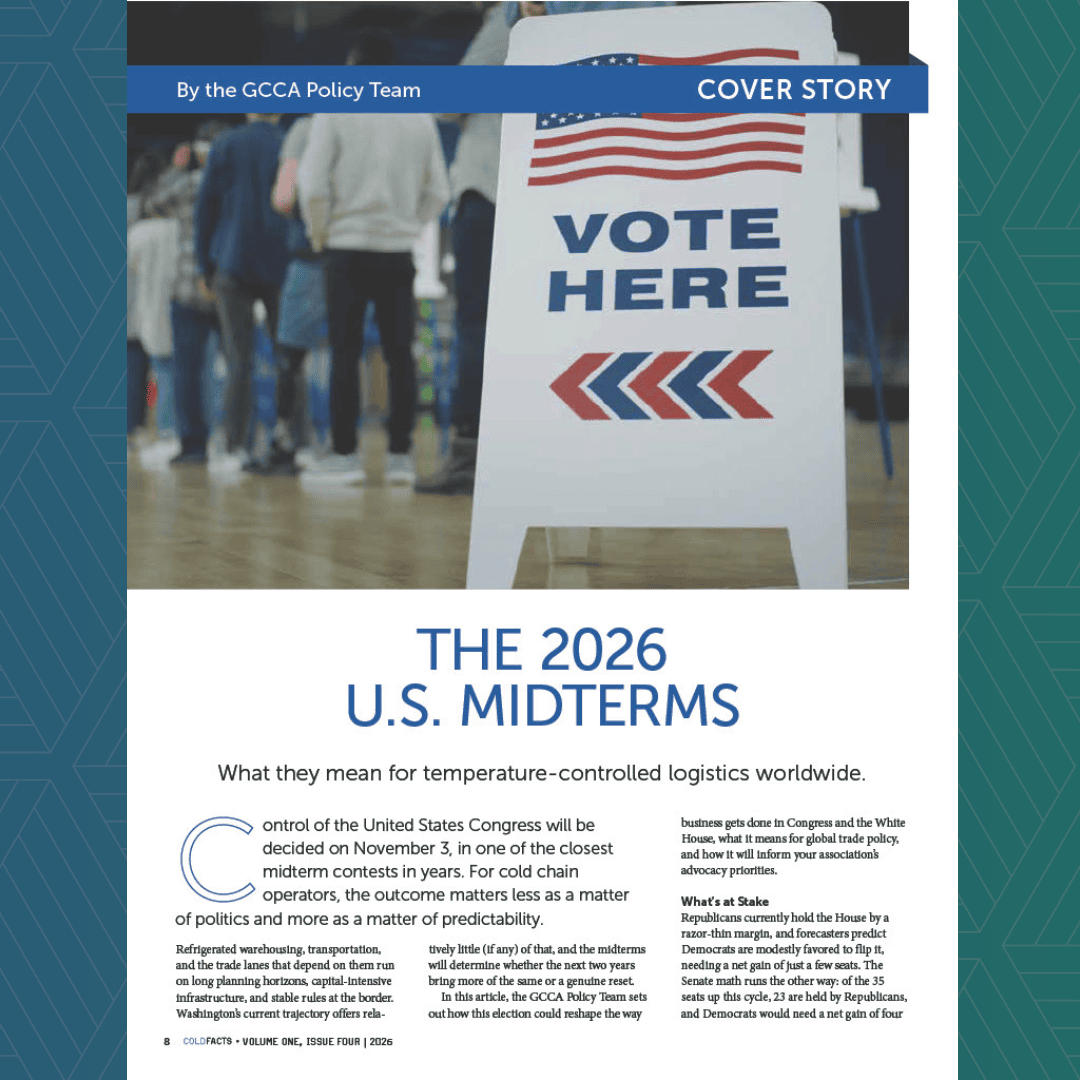
Control of the United States Congress will be decided on November 3, in one of the closest midterm contests in years. For cold chain operators, the outcome matters less as a matter of politics and more as a matter of predictability.
Refrigerated warehousing, transportation, and the trade lanes that depend on them run on long planning horizons, capital-intensive infrastructure, and stable rules at the border. Washington’s current trajectory offers relatively little (if any) of that, and the midterms will determine whether the next two years bring more of the same or a genuine reset.
In this article, the GCCA Policy Team sets out how this election could reshape the way business gets done in Congress and the White House, what it means for global trade policy, and how it will inform your association’s advocacy priorities.
What’s at Stake
Republicans currently hold the House by a razor-thin margin, and forecasters predict Democrats are modestly favored to flip it, needing a net gain of just a few seats. The Senate math runs the other way: of the 35 seats up this cycle, 23 are held by Republicans, and Democrats would need a net gain of four to take control, a tall order given the states that are going to the polls.
The result is a real possibility of a split outcome. Either party could end up with full control of both chambers, but a divided Congress isn’t some fringe scenario, it’s genuinely on the table. Complicating the picture further is an unusually aggressive, multi-state redistricting fight that began in mid-2025. It has touched at least nine states, as both parties have redrawn congressional maps mid-decade in pursuit of extra – seats actions – rarely, if ever, seen in modern times.
Whatever the outcome, the record number of retirements alone means that the Congress convening in January 2027 will include an unusually large wave of new members. At GCCA, we expect to reintroduce ourselves and our issues to a meaningfully changed roster of lawmakers on both sides of the aisle.
How Business Gets Done
The current Congress has operated under a one- or two-vote margin for most of the year, and that has shaped how legislation has both moved and failed to move. The federal government has already experienced two shutdowns in 2026, tied to disputes over immigration enforcement policy, and a further funding deadline falls at the end of September, just five weeks before voters go to the polls.
Narrow majorities of this kind tend to concentrate power in the hands of a small number of swing members and committee chairs, making must-pass legislation like appropriations bills unpredictable. This also pushes more policymaking toward the executive branch, where agencies can act through rulemaking and executive orders without needing floor votes.
For cold chain businesses, this has practical implications. Regulatory certainty is increasingly coming from agencies such as the Environmental Protection Agency (EPA), the U.S. Department of Agriculture (USDA), and the Food and Drug Administration (FDA), rather than from statute. Currently, relationships with agency staff and career regulators carry as much weight as relationships with members of Congress. A change in House or Senate control would not eliminate this dynamic, but it would change which committees hold gavels, which chairs set hearing agendas, and how much appetite there is for using appropriations riders or oversight hearings to shape agency behavior.
GCCA will continue to be at the table in these conversations, advocating for pro-business solutions and long-term stability to bring predictability back to business and investment decisions. Engaging regulators early both career staff and political appointees –has never mattered more. We must ensure they grasp the nuances of the cold chain and the role third-party logistics providers play in the overall supply chain.
Global Trade Policy in Flux
Trade policy is where the stakes for the cold chain are most direct, and 2026 has already been an eventful year regardless of the midterm outcome. The administration’s tariff agenda has expanded to include new duties tied to forced labor concerns, proclamations affecting semiconductors and critical minerals, and ongoing evaluation of further Section 301 action covering agricultural policy and pharmaceutical pricing, alongside exemptions carved out for a wide range of agricultural imports.
Most consequential for the cold chain specifically is the USMCA joint review. The United States declined to confirm a 16-year extension of the agreement on July 1, even as Mexico and Canada both confirmed their support. This means the three countries now move into a cycle of annual reviews rather than a settled multi-year framework.
The agreement remains in force, and a longer extension is still possible at any point. However, the shift introduces a new layer of uncertainty into the roughly $1.6 to $2 trillion in annual trilateral trade that depends on predictable customs, sanitary and phytosanitary, and tariff treatment. For an industry that moves perishable food and pharmaceuticals across borders on tight timelines, as cold chain operators know only too well, uncertainty at the border is costlier than any single tariff line.
The World Is Watching
Foreign governments negotiating with Washington know that most of the tariff authority driving current trade tensions, from anticompetitive practice investigations to reciprocal tariff proclamations, sits with the President and does not require congressional approval. A change in House or Senate control will not, by itself, unwind existing tariffs or reopen settled frameworks like the EU deal or the Brazil measures.
What it does change is negotiating positions. A Republican Congress has given the administration a relatively free hand to set trade policy through executive action with little institutional pushback; a Democratic House would bring more oversight hearings, more scrutiny of tariff justifications, and a louder platform for critics of the administration’s approach, even without the votes to reverse it outright.
Trading partners are watching for that shift because it affects timing as much as substance. Capitals, weighing whether to make concessions now or wait out the remainder of the term, will read a divided Congress, and the political weakening it implies, as a reason to slow-walk rather than settle.
A unified Republican Congress, by contrast, signals sustained leverage and less incentive for Washington to compromise. Either way, the midterms are being watched abroad less as a referendum on trade policy itself and more as a gauge of how much runway the president has left for enforcement.
Advocacy Priorities and the Road Ahead
None of this changes the fundamentals of GCCA’s global legislative and regulatory framework, but it does sharpen where the association’s energy will go over the next two years.
The case for predictable, evidence-based infrastructure incentives grows stronger as businesses hold back capital in the face of fiscal uncertainty. Trusted partner programs and digital SPS clearance remain the most direct way to keep goods moving even when the politics of trade are unsettled. More relevant than at any point in recent memory, GCCA will continue to have a role as a counterweight to protectionist instincts, on both sides of the aisle and in trading partner capitals. The EPA’s decision to extend the compliance deadline for low-GWP refrigerants in cold storage warehouses to 2032 remains a useful proof point that patient, evidence-led engagement with regulators can secure workable outcomes even amid political turbulence elsewhere.
What will need to change after November is the breadth of engagement: a closely divided Congress, a wave of new members following an unusually aggressive redistricting cycle, an executive branch driving more policy through agency rulemaking, and a trading environment where governments worldwide are all recalibrating in real time, all point toward the same conclusion.
GCCA’s advocacy in Washington will be broad-based, responsive to member need, bipartisan by design, and sustained well beyond election night. The businesses that move the world’s food and medicine across borders do not have the luxury of waiting for political certainty before they invest, hire, and build.
***
Contact Us
COLD FACTS Magazine and media inquiries: Lindsay Shelton-Gross, Senior Vice President, Global Communications, Marketing and Strategic Initiatives, Global Cold Chain Alliance
Editorial Ideas: Please contact Editor-In-Chief Alexandra Walsh
Advertising Opportunities: Contact Jeff Rhodes, Vice President of Sales, MCI USA Sales