Cold Facts Magazine
The Cold Chain and American Ingenuity
A timeline of 250 years of progress and 20 examples of creative resourcefulness.
The United States celebrated its 250th birthday on July 4, 2026. Over those 250 years, the progression of the cold chain has exemplified American ingenuity: advancing chemistry, mechanics, transportation logistics, food and pharmaceutical science, and technologies like software and sensors. Few innovations have touched as many American lives, for as long, as those that allow us to keep things cold.
1. The Natural Ice Trade (early 1800s)
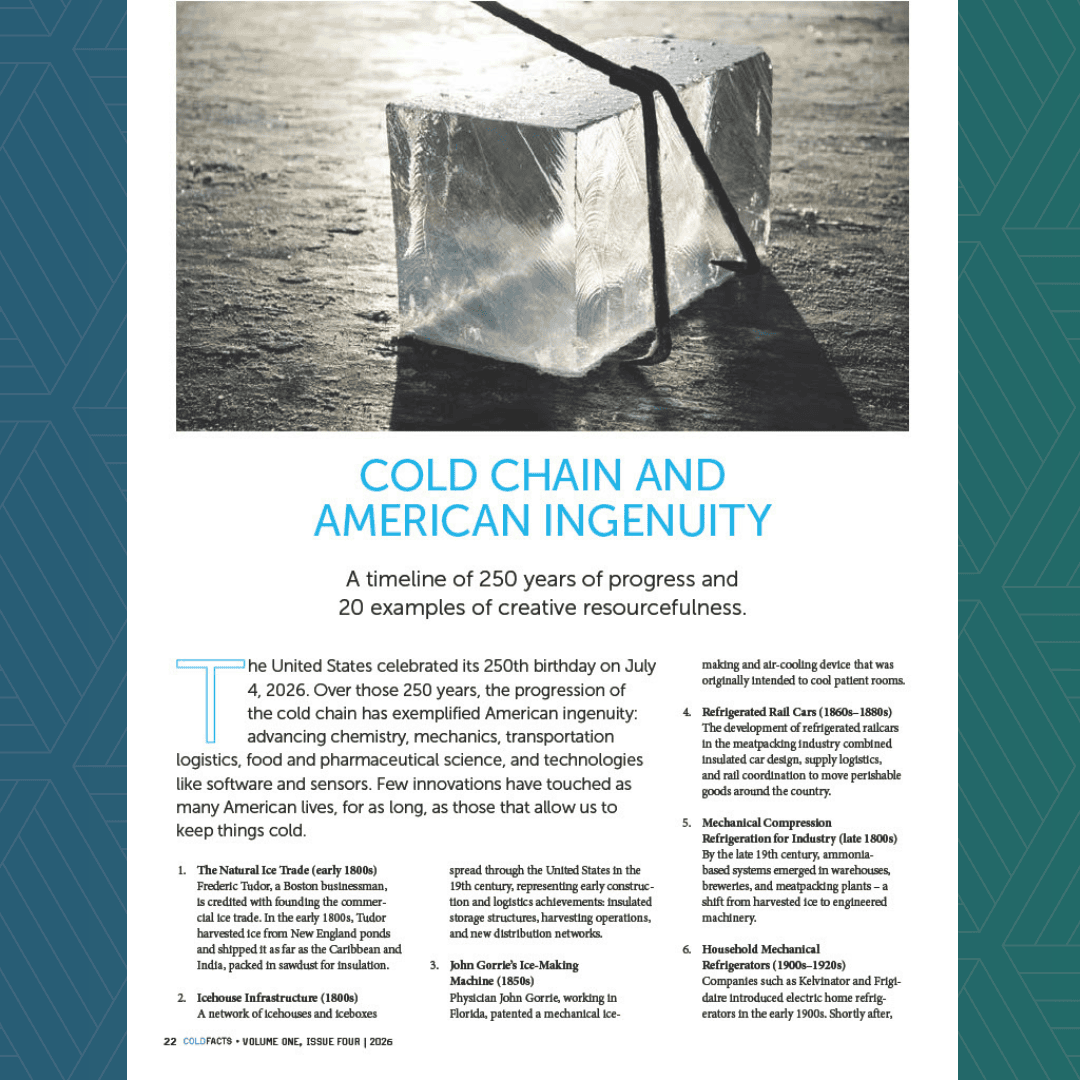
Frederic Tudor, a Boston businessman, is credited with founding the commercial ice trade. In the early 1800s, Tudor harvested ice from New England ponds and shipped it as far as the Caribbean and India, packed in sawdust for insulation.
2. Icehouse Infrastructure (1800s)
A network of icehouses and iceboxes spread through the United States in the 19th century, representing early construction and logistics achievements: insulated storage structures, harvesting operations, and new distribution networks.
3. John Gorrie’s Ice-Making Machine (1850s)
Physician John Gorrie, working in Florida, patented a mechanical ice-making and air-cooling device that was originally intended to cool patient rooms.
4. Refrigerated Rail Cars (1860s–1880s)
The development of refrigerated railcars in the meatpacking industry combined insulated car design, supply logistics, and rail coordination to move perishable goods around the country.
5. Mechanical Compression Refrigeration for Industry (late 1800s)
By the late 19th century, ammonia-based systems emerged in warehouses, breweries, and meatpacking plants – a shift from harvested ice to engineered machinery.
6. Household Mechanical Refrigerators (1900s–1920s)
Companies such as Kelvinator and Frigidaire introduced electric home refrigerators in the early 1900s. Shortly after, mechanical refrigerators began to make their way into American households.
 7. Clarence Birdseye and Flash Freezing (1920s)
Clarence Frank Birdseye II was an American inventor, entrepreneur, and naturalist regarded as the founder of the modern frozen food industry. He developed and commercialized a quick-freezing process for food in the 1920s.
8. Synthetic Refrigerants (1930s)
Thomas Midgley Jr. and colleagues at General Motors and Frigidaire developed chlorofluorocarbon (CFC) refrigerants, like Freon, in the early 1930s.
9. Mechanical Refrigerated Trucking (Reefer Trucks) (1930s)
Frederick McKinley Jones is commonly credited with developing a practical automatic refrigeration unit for trucks in the 1930s. This was a major advance, moving some refrigerated transport from rail routes, enabling door-to-door cold delivery by highway.
10. Intermodal Refrigerated Shipping Containers (Reefer Containers) (mid-to-late 20th century)
The adoption of standardized, self-refrigerating shipping containers, building on the major intermodal container revolution of the 1950s, allowed frozen and chilled goods to move seamlessly between ship, rail, and truck.
11. Long-Haul Interstate Trucking Networks and the Interstate Highway System (1950s–1970s)
The construction of the U.S. Interstate Highway System, beginning in 1956, substantially expanded the reach and reliability of refrigerated trucking.
12. USDA and Academia Move Food Science Research Forward (late 19th century–today)
The U.S. Department of Agriculture (USDA) and land-grant universities across the country remain key contributors to research on food preservation, cold storage practices, and shelf-life science. For those looking to go deeper on these topics, GCCA’s Council of Scientific Advisors offers valuable expertise and insight worth exploring.
13. Pharmaceutical and Vaccine Cold Chain Research (20th century–today)
Cold chain logistics for pharmaceuticals – particularly vaccines requiring precise temperature ranges, including some requiring deep-freeze or ultra-cold storage – became a significant area of applied research, with visibility increasing markedly during COVID-19 pandemic vaccine distribution efforts.
14. Food Safety Regulation and Cold Chain Standards (late 20th century–today)
Regulatory frameworks such as the Food Safety Modernization Act (FSMA) established more rigorous cold-chain and traceability requirements for food transportation.
15. Air Cargo Cold Chain (mid-20th century–today)
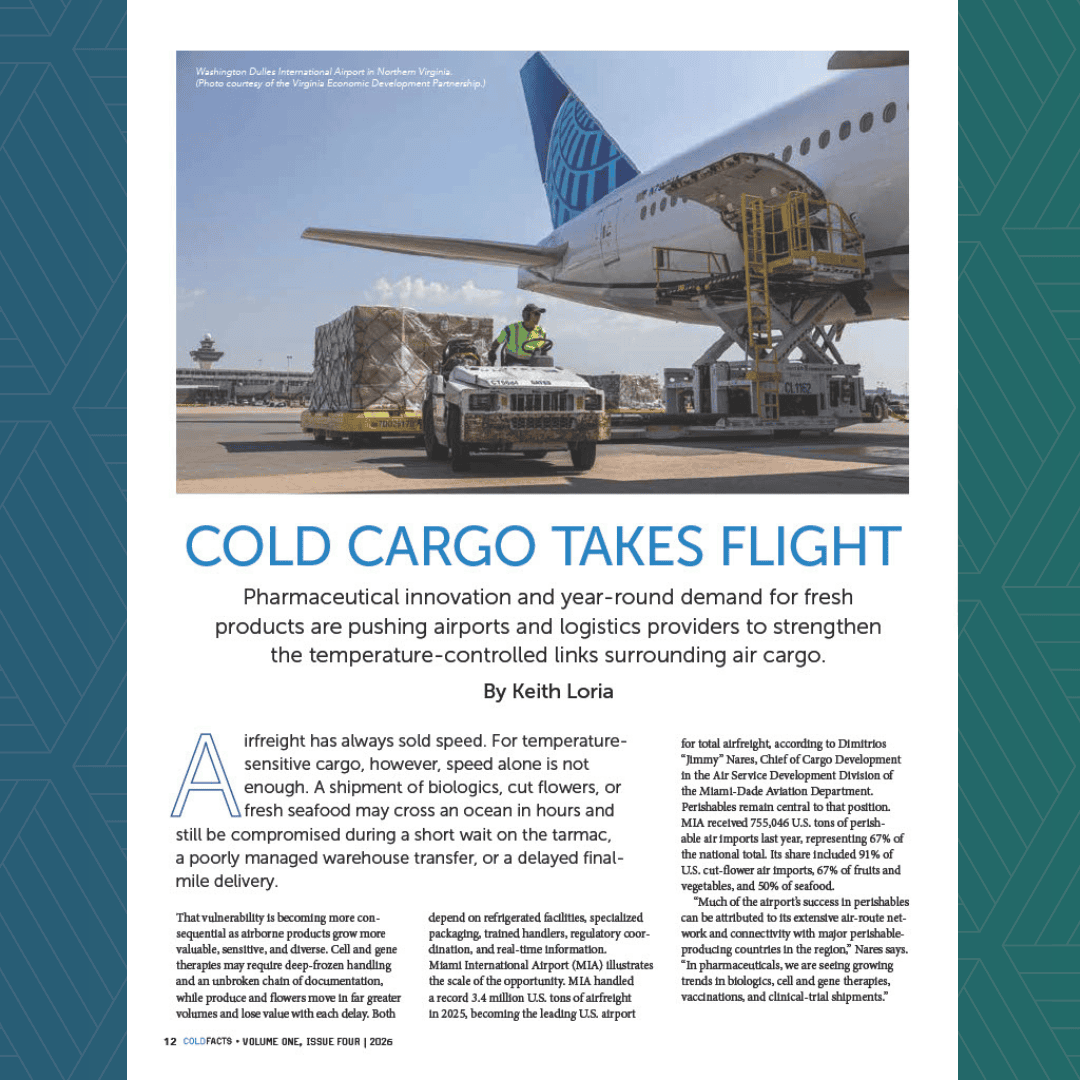
The growth of temperature-controlled air freight, including specialized packaging (insulated containers, dry ice, gel packs) and airline cold chain handling procedures, expanded the cold chain to time sensitive goods such as fresh seafood, cut flowers, and vaccines. Check out page 12 for this issue’s story on air cargo.
16. Automated Warehousing and Robotics (late 20th century–today)
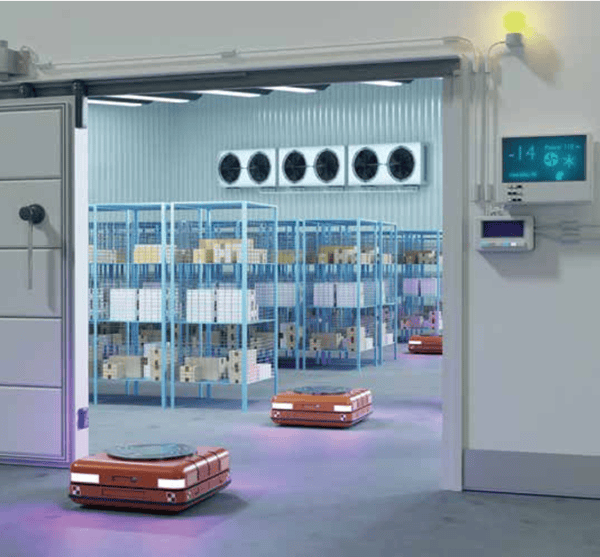
Automated storage and retrieval systems, robotics, and warehouse automation have increasingly been applied to cold storage facilities, partly because automation reduces the amount of time workers need to spend in extreme cold environments.
17. Real-Time Monitoring, IoT Sensors, and Data Logging (2000s–today)
Temperature and humidity sensors connected to networked monitoring systems are increasingly common across the cold chain, allowing real-time tracking of shipments and storage facilities – a fast-moving area of technology with new innovations constantly emerging.
18. Additional Emerging Technologies
Areas such as blockchain-based traceability, predictive analytics for cold chain failure prevention, and alternative refrigerants with low global warming potential are active areas of innovation and development.
19. The Cold Chain Workforce
Academia, research, and professional and trade associations like GCCA and many of our partner organizations have played important roles in standardizing refrigeration engineering practice and educating and training the cold chain workforce.
20. Industry Standards and Trade Organizations
GCCA coordinates industry best practices, market intelligence, education and training, research, networking, and pro-industry advocacy and policymaking for cold storage and cold-chain logistics … both in the United States and around the world.
Distance, climate, or time should never limit access to safe food for Americans. From the icehouses of the colonial era to the sensor laden trucks and freezers of today, the cold chain has shaped the American story… and what America eats. As the nation marks 250 years, each generation of cold chain professionals is building on previous innovations: keeping food fresh, medicine viable, and communities healthy.
***
Contact Us
COLD FACTS Magazine and media inquiries: Lindsay Shelton-Gross, Senior Vice President, Global Communications, Marketing and Strategic Initiatives, Global Cold Chain Alliance
Editorial Ideas: Please contact Editor-In-Chief Alexandra Walsh
Advertising Opportunities: Contact Jeff Rhodes, Vice President of Sales, MCI USA Sales